Quick Answer: ClickUp vs. Asana: Both are project management solutions, but each takes a different approach to managing work.ClickUp stands out with its wide range of project views, built-in time tracking, integrated Docs, and advanced sprint management—all while offering competitive pricing. Asana, on the other hand, focuses on simplicity. Its intuitive setup and straightforward onboarding make it a strong choice for teams that prefer an organised workflow without spending time customising their workspace.
In this comparison, we’ll look at ClickUp vs. Asana across key features, pricing, and common use cases to help you determine which platform best matches your team’s needs and working style
ClickUp vs Asana: Features and Usability
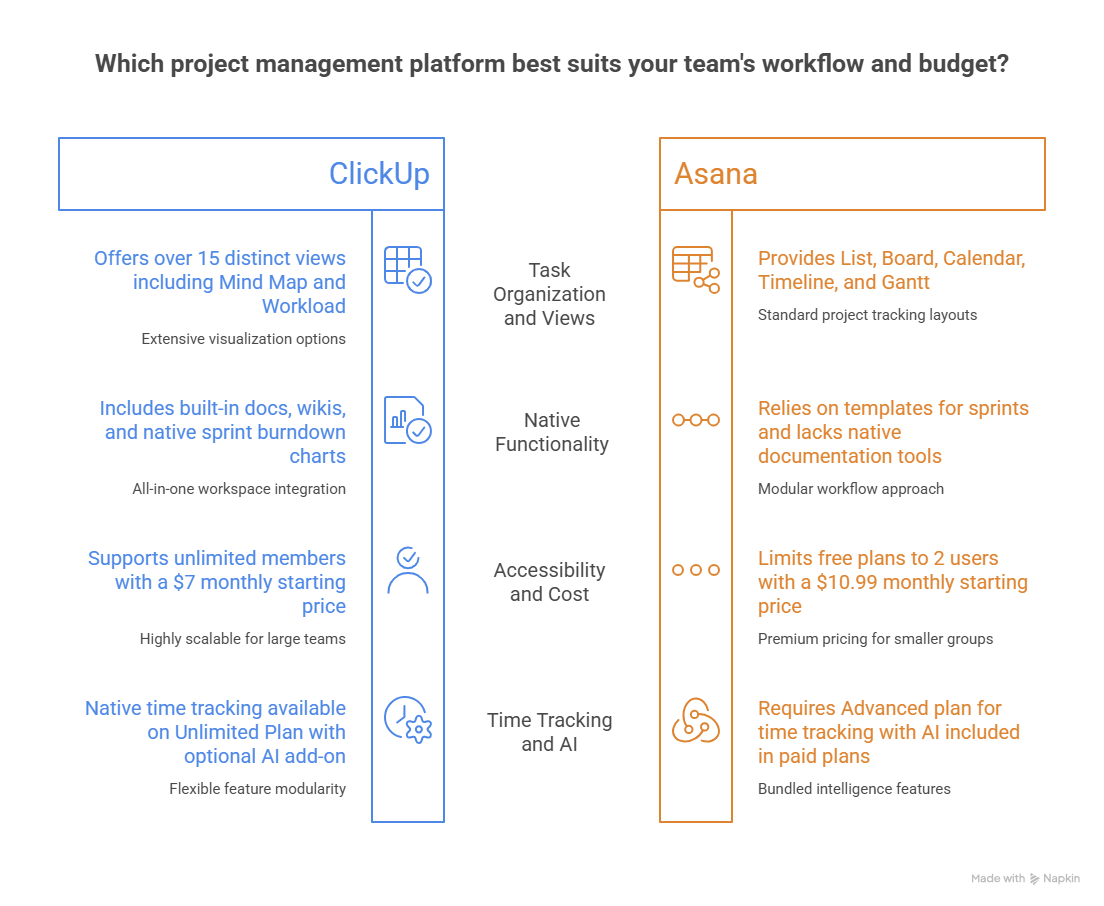
Feature density is where ClickUp separates itself in almost every ClickUp vs Asana comparison. ClickUp offers over 15 project views — List, Board, Gantt, Calendar, Workload, Mind Map, and more — plus native docs, whiteboards, and chat bundled into one workspace. ClickUp also supports over 1,000 integrations, compared to roughly 400 for Asana.
Asana’s strength is focus. It doesn’t try to be a chat app or a wiki — it does task management, project workflows, and portfolio visibility extremely well. Asana’s Goals and OKR framework is widely regarded as the most polished objective-tracking system in the category, connecting company, team, and individual goals directly to daily task completion.
ClickUp vs. Asana: Which Should You Use?
The right side of the ClickUp vs Asana decision comes down to what your team actually needs day-to-day, not which platform has the longer feature list.
Choose Asana if:
- You want a tool focused purely on project and task management, not an all-in-one workspace
- You’d rather have AI capabilities bundled into your paid plan than pay for a separate add-on
- Unlimited automations and a no-code AI workflow builder matter more to you than raw feature count
- You need enterprise-grade planning tools like Strategy Maps and weighted goal tracking
Choose ClickUp if:
- You want a single workspace that replaces several disconnected tools — docs, chat, whiteboards, and task management together
- A generous free plan with unlimited users and a solid monthly automation allowance is a priority
- You’re comfortable paying extra for AI on top of your base subscription
- Built-in collaboration features like docs, whiteboards, and native chat need to live inside the same tool as your task management
Both platforms are strong, established players in project management, and neither choice is wrong — it’s a question of fit. ClickUp tends to appeal to teams that want maximum flexibility and are willing to invest time configuring it; Asana tends to appeal to teams that want dependable, no-frills project management that’s easy to roll out. For teams actively researching alternatives, ClickUp is frequently cited as one of the strongest options to consider alongside Asana, while Asana remains the dependable, well-established choice many teams default to.
The Real Problem: It’s Rarely the Tool
Here’s what most ClickUp vs Asana comparisons don’t tell you: the platform you pick matters less than what happens after go-live. Industry data paints a sobering picture of why software rollouts stall:
- Teams lose roughly 60% of their time switching, searching, and syncing across disconnected tools.
- Only 12% of employees use AI daily, according to Gallup.
- Just 5% of enterprise AI pilots succeed, according to MIT.
- 70% of digital transformations miss their objectives, according to McKinsey.
Licenses get purchased, dashboards get built, AI gets bolted on — and six months later, teams quietly slip back to WhatsApp and spreadsheets because the workspace was never actually built around how the business really works. This is exactly the gap Dtech Systems was built to close.
Where Dtech Fits Into the ClickUp vs Asana Decision
Dtech is a Diamond ClickUp and Anthropic partner operating out of Riyadh and London, with 200+ projects delivered and a 4.8 rating on Clutch. Rather than selling a license and walking away, Dtech maps your actual business processes first, then builds the ClickUp workspace around that reality — hierarchy, automations, integrations, and dashboards — and stays through adoption until the new system becomes habit, not just another login.
Every ClickUp license bought through Dtech comes with one free adoption hour, and the firm offers a free first session on a real workflow before anything is purchased, since Dtech’s own positioning is built on being measured on actual adoption, not just the sale.
Frequently Asked Questions (FAQs)
Is ClickUp cheaper than Asana?
Yes, at almost every tier. ClickUp’s paid plans start at $7/user/month versus Asana’s $10.99/user/month, and the gap widens at the mid-tier — ClickUp Business ($12/user/month) costs roughly 52% less than Asana Advanced ($24.99/user/month). The exception is AI: once you add ClickUp’s $9/user/month Brain MAX add-on, Asana’s bundled AI on its Starter tier can be cheaper for smaller teams.
Can I migrate from Asana to ClickUp? Is there a built-in feature for this?
Yes. ClickUp has a native Asana import tool built directly into the platform — you don’t need a third-party app or manual re-entry. It pulls over your projects, tasks, subtasks, due dates, assignees, custom fields, and comments in a few clicks, then maps them into ClickUp’s Lists and Spaces automatically. For most small-to-mid-sized workspaces, the native importer handles the bulk of the move on its own. Where it gets trickier is on the process side: automations, dashboards, and custom statuses built around how Asana was configured don’t always translate one-to-one, and complex multi-team workspaces often need rework rather than a straight import. This is exactly the gap a migration partner closes
Do I need a consultant to implement ClickUp or Asana?
Not strictly, but adoption data suggests it helps. Partners like Dtech Systems specialize in mapping your actual workflows into ClickUp and coaching teams through adoption, rather than leaving a business to configure a blank workspace alone.

We are a team of experienced software professionals with years in delivering tailored solutions companies. We understand the local market, driving innovation and business success.