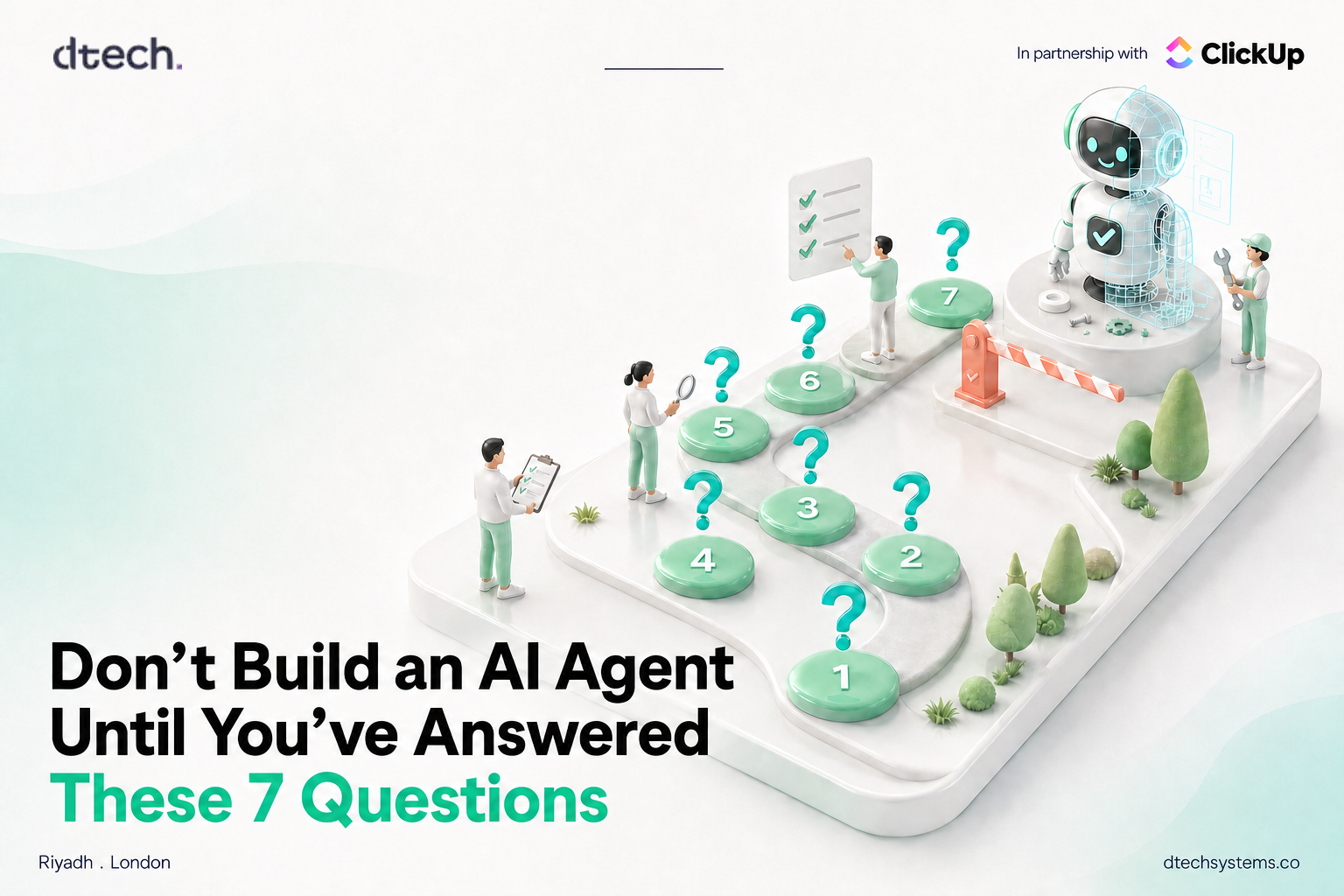
Don't build an AI agent until you've answered these 7 questions.
An agent is reasoning you're paying for. Before you build an AI agent, make sure you actually need the reasoning — not just a faster version of the guesswork.
Seven questions, each with a real example, a live readiness score, and a verdict at the end.
Most agent failures aren't model failures.
When a new AI agent goes wrong, the instinct is to blame the model. Almost always, the real cause was further upstream — a question nobody asked before building started. The agent didn't fail at reasoning. It failed because the thing it was reasoning about was never actually ready for it.
An agent making decisions inside an unanswered question just makes bad decisions faster, with more confidence.
Answer these seven first, honestly, before a single prompt gets written.
None of these questions are about the model. GPT, Claude, or anything else will reason well if what it's reasoning about is sound. The seven questions below are entirely about whether the ground underneath is actually solid enough to build an AI agent on.
The 7 questions, one at a time.
Open each one, answer honestly, and watch your readiness score below. This is the exact checklist we run through before we build an AI agent for any client.
Two ways this usually plays out.
A team decides to build an AI agent fast, it looks impressive in the demo, then starts making calls nobody can explain. No one owns the fix, the data it leans on turns out to be half-stale, and after a few bad calls the team quietly stops trusting it and goes back to doing the task by hand.
The workflow gets fixed before anyone tries to build an AI agent on top of it. One person owns reviewing its output weekly. When it hits something it can't handle, it hands off cleanly instead of guessing. Six months later it's still running, and nobody's had to think about it since week one.
Run this as a 30-minute meeting, not a solo checklist.
Before any team tries to build an AI agent, this is worth doing together, out loud, in one sitting.
- Pull in whoever actually owns the process today, not just whoever's excited about the agent.
- Go through the 7 questions together and answer each one out loud before marking it.
- For every "Not yet," write down who closes that gap and by when.
- Only start building the agent once the readiness score below reads 7 of 7 honestly, not optimistically.
Are you ready to build an AI agent?
Your score here is a direct answer to the question in the heading — not a vibe check.
Your readiness verdict will appear here as you go.
Quick answers.
What if we fail more than one question?
Fix the highest-leverage one first — usually accountability or data quality. An agent built on either of those gaps tends to produce confidently wrong output rather than failing loudly, which is worse than not building it yet.
Does failing a question mean we should automate instead?
Often, yes. If the task is actually a fixed rule — same trigger, same action, every time — a simple automation is cheaper and more reliable than an agent, and doesn't need all 7 questions answered the same way.
Can we build the agent while we're still fixing a gap?
You can prototype in parallel, but don't ship it to real users until the gap is closed. A convincing demo is not the same thing as being ready to build an AI agent your team will actually trust.
How often should we re-ask these questions?
Any time the underlying process changes meaningfully — new data sources, a new team handling it, a new scale of volume. An agent that passed these questions a year ago isn't guaranteed to still pass them today.
Who should be in the room when we run through these questions?
Whoever owns the process today, not just whoever's proposing the agent. The person closest to the actual workflow usually spots the "not yet" answers the fastest.
What's the single most commonly skipped question?
Accountability. Teams are quick to confirm the data looks fine and the rule-vs-decision line is clear, but naming one person responsible before they build an AI agent is the step most often left undone.
We'll help you answer these before you build anything.
Most "agent didn't work" conversations are actually one of these seven questions, unanswered. We audit the workflow first, then build an AI agent that's actually worth building, not just technically possible.