Workflow automation vs process optimisation: what's the difference?
They get used interchangeably in almost every pitch deck. They are not the same move, and doing one when you needed the other wastes budget either way.
This guide breaks down the workflow automation vs process optimisation question so you know which one your process needs, and in what order.
Workflow Automation vs Process Optimisation: One Fixes the Route
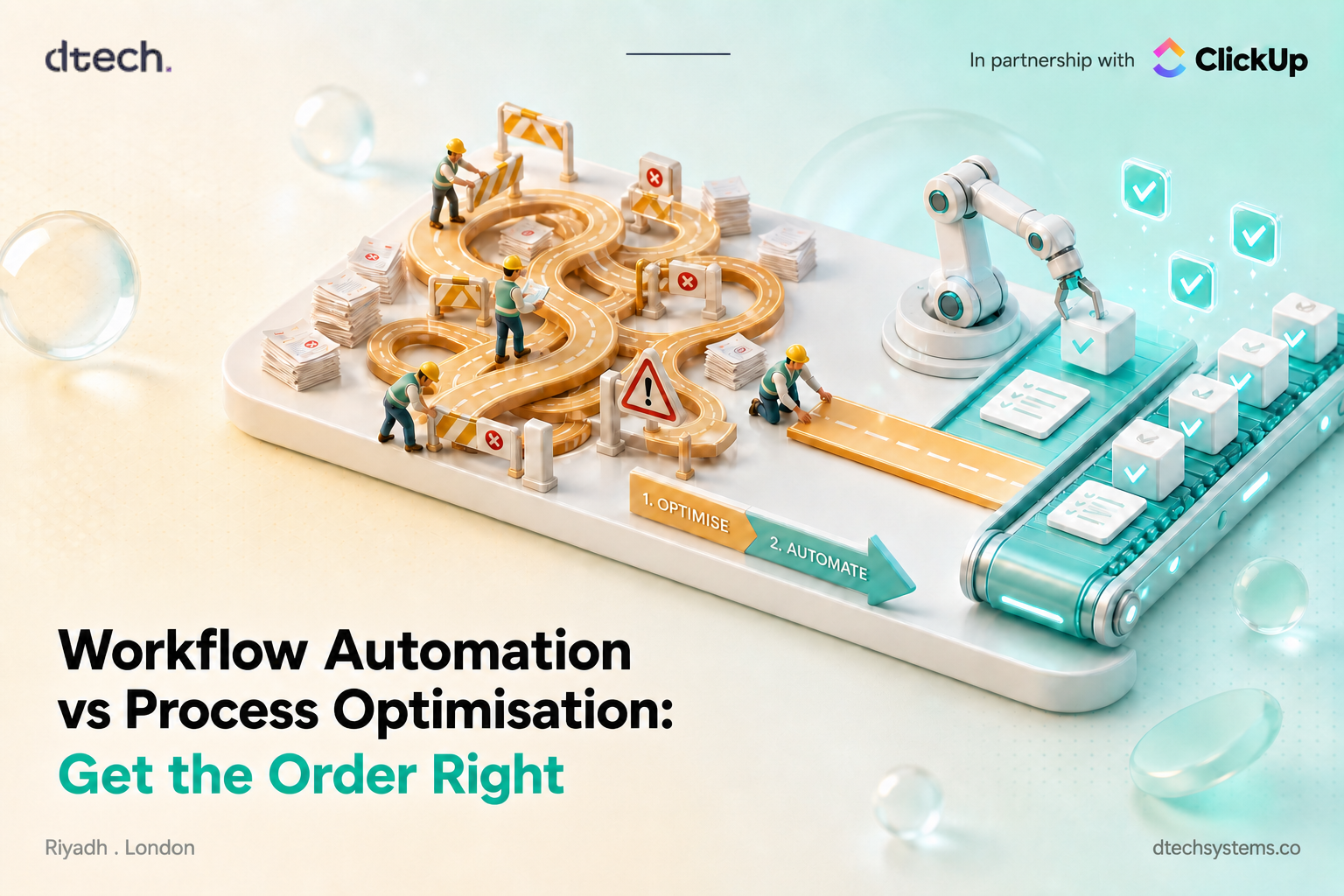
In the workflow automation vs process optimisation comparison, process optimisation asks whether the steps themselves are the right steps. Workflow automation asks whether a human still needs to perform a step that's already correct. Confuse the two, and you either automate a bad process faster, or spend months refining a process that should have just been handed to a machine.
Fixing the route
Redesigning the sequence of steps: removing redundant approvals, merging duplicate handoffs, reordering work so less of it waits on someone else. The process changes. Who does the work may not.
Fixing who walks it
Taking an already-correct, repetitive step and having a system execute it instead of a person. The steps stay the same. A rule or tool just runs them instead of a human clicking through manually.
Workflow Automation vs Process Optimisation: Where Does Your Problem Sit?
Pick a scenario and watch where it lands on the spectrum.
The verdict and reasoning will appear here.
Workflow Automation vs Process Optimisation: The Expensive Mix-Up
A broken process, run by a machine, still produces the broken outcome. It just produces it faster, and with more confidence.
This is the single most common waste of AI and automation budget: teams point a tool at a process nobody has actually fixed. The redundant approval step doesn't disappear because a bot clicks through it. The unclear ownership doesn't resolve because a rule routes the task somewhere. Automation removes manual effort. It does not remove bad design. Getting workflow automation vs process optimisation backwards is exactly how this happens.
The inverse mistake costs just as much, slower: optimising a process that was always going to be automated away. Polishing a manual data-entry step that should have been eliminated entirely is time spent making the wrong thing slightly less painful.
Workflow Automation vs Process Optimisation: How They Work Together
- Map the process as it's actually run, not as it's documented. Most of the waste hides in the gap between the two.
- Remove or merge anything that doesn't need to exist: duplicate approvals, redundant checks, steps nobody remembers the reason for.
- Of what's left, separate rule from judgment. Same trigger, same action every time is a rule. Anything context-dependent isn't.
- Automate the rules. That's where automation earns its cost: on a process that's already correct.
- Review both on a schedule. A process that was optimal a year ago, and an automation built on top of it, can both drift as the team and the work change.
Workflow Automation vs Process Optimisation: Which One First?
Tap whatever's true for the process you're thinking about, and see which side of the workflow automation vs process optimisation line it falls on.
Your lean will show here once you've picked at least two.
Workflow Automation vs Process Optimisation: Quick Answers
Can you automate and optimise at the same time?
You can plan both at once, but sequence the work: optimise the steps first, even informally, before automating any of them. Automating a step you're about to remove is wasted build time.
Which one is cheaper to get wrong?
Optimising without automating is the cheaper mistake: it costs time, not a broken system in production. Automating a broken process is the expensive one, because it ships the error at scale with more apparent confidence.
Do small teams need to separate these at all?
Yes, even informally. A five-person team can still automate a redundant approval step without realising the step itself should have been cut first.
How often should a process be re-optimised?
Any time the team, tools, or volume changes meaningfully. A process designed for 10 people doesn't automatically still fit at 40, automated or not.
Workflow Automation vs Process Optimisation: We Get the Order Right
Optimisation and automation solve different problems. We help you tell which one your workflow actually needs, in what order, before any build starts.