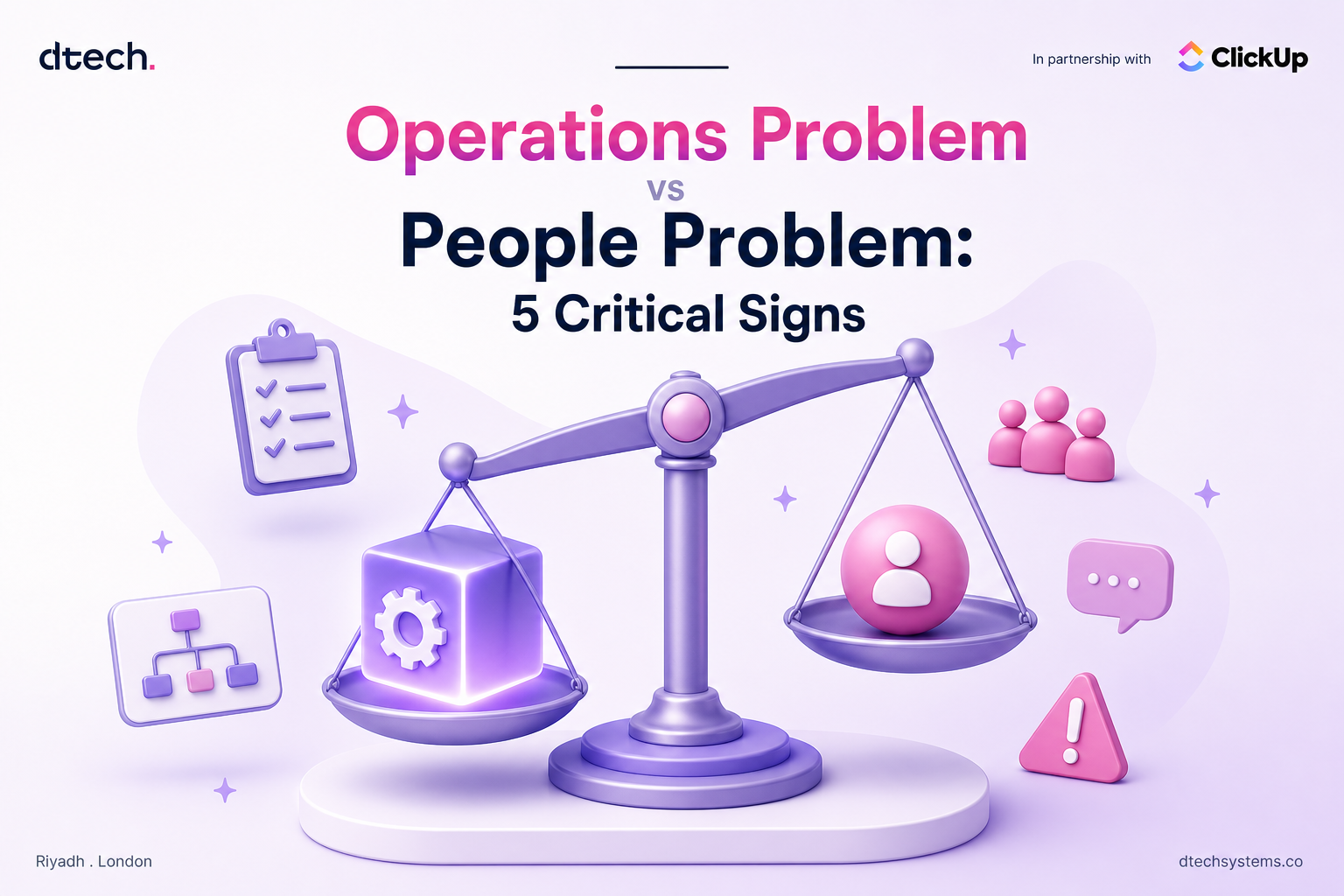
Operations problem vs people problem — it's the question every leader eventually has to answer. The same mistake keeps happening, the same deadline keeps slipping, the same task keeps falling through the cracks — and it's always a different person doing it. That's usually the first clue, and most leaders get the diagnosis wrong.
The instinct is to fix the person. Retrain them. Warn them. Replace them. But if the same failure keeps showing up regardless of who's sitting in the seat, the person was never the variable. The workflow was.
Here are five signs that what looks like a people problem is actually an operations problem — and what to do once you've spotted it.
1. Operations Problem vs People Problem: The Failure Follows the Role, Not the Person
If you've replaced someone in a role and the exact same issue reappeared with their replacement, that's the clearest signal in the entire operations problem vs people problem diagnosis. A person problem is specific to an individual — it goes away when they do. A process problem is specific to the role, and it will keep resurfacing with whoever fills it, because the role itself was never set up to succeed.
Ask: has this exact failure happened with more than one person in this position? If yes, you're not managing a performance issue. You're managing a broken handoff, an unclear responsibility, or a step that was never actually defined.
2. Operations Problem vs People Problem: Everyone Has a Workaround
When a process works, people follow it. When a process doesn't, people quietly build their own version of it to get the job done — a personal spreadsheet, a side Slack channel, a manual double-check nobody asked for. Multiple people independently inventing the same workaround is a strong signal in the operations problem vs people problem question.
That's not a discipline issue. That's your team telling you, with their actions instead of their words, that the official process doesn't actually work. Punishing them for the workaround only removes your best evidence of where the real problem is.
Look back at the last several "what went wrong" conversations. If the answer keeps landing on an individual — "Sarah missed it," "the intern forgot," "someone dropped the ball" — without ever naming which step in the process allowed that to happen, the postmortem isn't finding the root cause. It's finding whoever was closest to the failure when it surfaced.
A genuine root-cause conversation should be able to answer: what in the process made it possible for one missed step to cause this outcome, with no safeguard catching it? If that question never gets asked, the operations problem vs people problem debate defaults to blaming people by omission, not by evidence.
4. Operations Problem vs People Problem: Good Performers Are Struggling Too
If your strongest, most capable people are hitting the same wall as your newest hires, that's rarely a talent gap. Skilled, motivated people generally find a way around a problem that's actually within their control. When even your best performers can't consistently avoid a specific failure, the constraint isn't skill — it's the system they're operating inside.
This is one of the fastest ways to separate the two in the operations problem vs people problem question: performance variance across skill levels points to a people issue; consistent failure regardless of skill level points to an operations issue.
5. Operations Problem vs People Problem: Nobody Can Say Who Owns the Step
Ask your team, one at a time, who is responsible for a specific step in a recurring process. If you get more than one confident but different answer — or a shrug — that ambiguity is the root cause, not a symptom of it. People can't be held accountable for ownership that was never clearly assigned to them in the first place.
Unclear ownership is one of the most common and most fixable causes behind what looks like an operations problem vs people problem debate. It's rarely anyone's fault individually, and it's almost always fixable by simply writing the ownership down somewhere everyone can see it.
Why This Distinction Matters
Getting the operations problem vs people problem diagnosis wrong is expensive in a way that doesn't show up on a spreadsheet. Coaching, retraining, or replacing someone to fix a process failure doesn't just fail to solve the problem — it teaches the next person in that role to expect blame instead of support, and it erodes trust across the team faster than the original failure ever did.
The good news is that operations problems are far easier to fix than people problems. You can't retrain your way out of a broken process, but you can redesign a broken process a lot faster than you can rebuild trust with a team that's been unfairly blamed for it.
What This Looks Like in Practice
Once a team correctly diagnoses an operations problem instead of a people problem, the fix usually involves the same three moves: make the process visible, assign clear ownership to every step, and remove the ambiguity around what "done" actually means. From there, some of it can be automated — status changes, reminders, handoffs — and some of it needs a person or an AI agent making a judgment call where context genuinely changes case by case, the same distinction covered in AI agents vs automation.