AI Adoption vs AI Transformation: 5 Steps to Real Value
Your team is already using AI. The real question is whether AI is changing how your company works, or just sitting next to it.


DTECH INSIGHTS
AI Adoption Is Not the Same as AI Transformation
Your team is already using AI. The real question is whether AI is changing how your company works, or just sitting next to it.
Your company may already be using AI. But AI adoption does not always mean AI is changing how your company works.
Employees may use AI to write emails, summarize documents, create reports or research ideas. The problem starts when everyone uses AI differently, managers do not know how to guide their teams, and useful AI workflows stay hidden with one person.
AI adoption is growing. The harder part is turning that adoption into real business value. Take the quick check below to see where your team stands today.
Health check
Is your team adopting AI, or transforming with it?
Tick every statement that is true for your team today.
Score: 0 / 6
Most teams start here. Tick the boxes above to get your verdict. Each one you cannot tick is a clear next step.
Giving People AI Is Only the First Step of AI Adoption
Buying AI tools is easy. Helping people use them well is much harder.
Gallup’s 2026 research shows that AI works better when it fits into existing work systems and when managers actively support their teams. Manager support and workflow integration are the two conditions most strongly linked with frequent AI use.
78% vs 44%Share of employees who use AI frequently when they strongly agree their manager supports AI use, compared with those who do not. Source: Gallup, 2026
Yet only 36% of employees in AI-integrating organizations strongly agree their manager actively supports their team’s AI use. That gap is where AI adoption stalls. It is not only an IT project. Managers have an important role to play.
They can help their teams:
- Find repetitive tasks that AI could handle
- Try AI on real work instead of random experiments
- Share useful AI workflows with the rest of the team
- Review AI-generated work before it is used
- Show employees how AI can make their existing work easier
The goal is not to make every employee an AI expert. It is to help people understand where AI actually fits into their work.
More AI Tools Can Also Create More Problems
Many companies now use several AI tools across different teams. One department uses one tool for writing, another for research, and another for AI agents and automation.
That creates a new problem: AI becomes scattered across the company.
WRITER’s 2026 enterprise AI survey found that 79% of organizations reported challenges with AI adoption, even as AI investment keeps growing. Many executives are struggling with strategy, security, governance and getting real value from AI.
Without a clear AI strategy, companies can end up with:
- Too many disconnected AI tools
- Employees creating their own processes
- Repeated work across different teams
- Unclear rules around company data
- AI workflows that nobody else knows how to use
- Tools that are purchased but rarely used
The answer is not necessarily fewer AI tools. It is a clearer way of using them.
Managers Turn AI Adoption Into Everyday Work
Think about a manager who tells their team, “We should start using AI.” That sounds useful, but it does not tell employees what to actually do.
A better approach is to look at the team’s daily work and ask simple questions:
- What takes the most time?
- What work is repeated every week?
- Where do people copy information from one place to another?
- Which reports take hours to prepare?
- Which tasks could AI prepare for a person to review?
These questions turn AI adoption into something practical. Once you know where the time goes, you can put a number on it.
Calculator
How much time is one repetitive task costing you?
Pick one task, like weekly status updates or turning call notes into tasks.
207 hours / year
That is about 4.5 hours back every week for the team.
Formula: hours × people × AI share × working weeks. We default to a conservative 30% because a person still reviews the work. This is an estimate for your own planning, not a benchmark.
Start With the Workflow, Not the Tool
A common mistake is starting with “Which AI tool should we buy?” A better question is “Where are our people losing time?”
Maybe a project manager spends every Friday collecting updates. Maybe a sales team spends hours entering information after calls. Maybe HR answers the same questions from employees again and again. These are better places to start with AI automation.
Once you understand the workflow, you can decide what AI should actually do. It might:
- Summarize information
- Create a task
- Write a first draft
- Find missing information
- Send a notification
- Update a status
- Prepare a report
- Start the next step in a workflow
The technology should support the process, not the other way around.
KEEP READING
Related articles
تبني الذكاء الاصطناعي ليس تحولًا: دليل عملي للمديرين
قد تكون شركتك تستخدم الذكاء الاصطناعي بالفعل، لكن هذا لا يعني دائمًا أن الذكاء الاصطناعي يُغيّر طريقة عمل شركتك.
وكلاء الذكاء الاصطناعي في ClickUp: 5 طرق عملية لتوفير الوقت
ماذا لو استطاع فريقك قضاء وقت أقل في الأعمال المتكررة، ووقت أكثر في الأعمال المهمة فعلًا؟
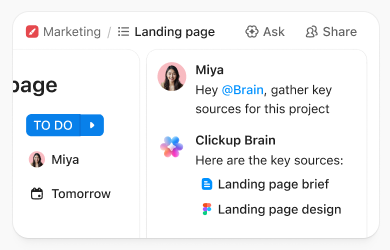
Build an AI Agent? 7 Critical Questions to Ask First
An agent is reasoning you're paying for. Before you build an AI agent, make sure you actually need the reasoning — not just a…