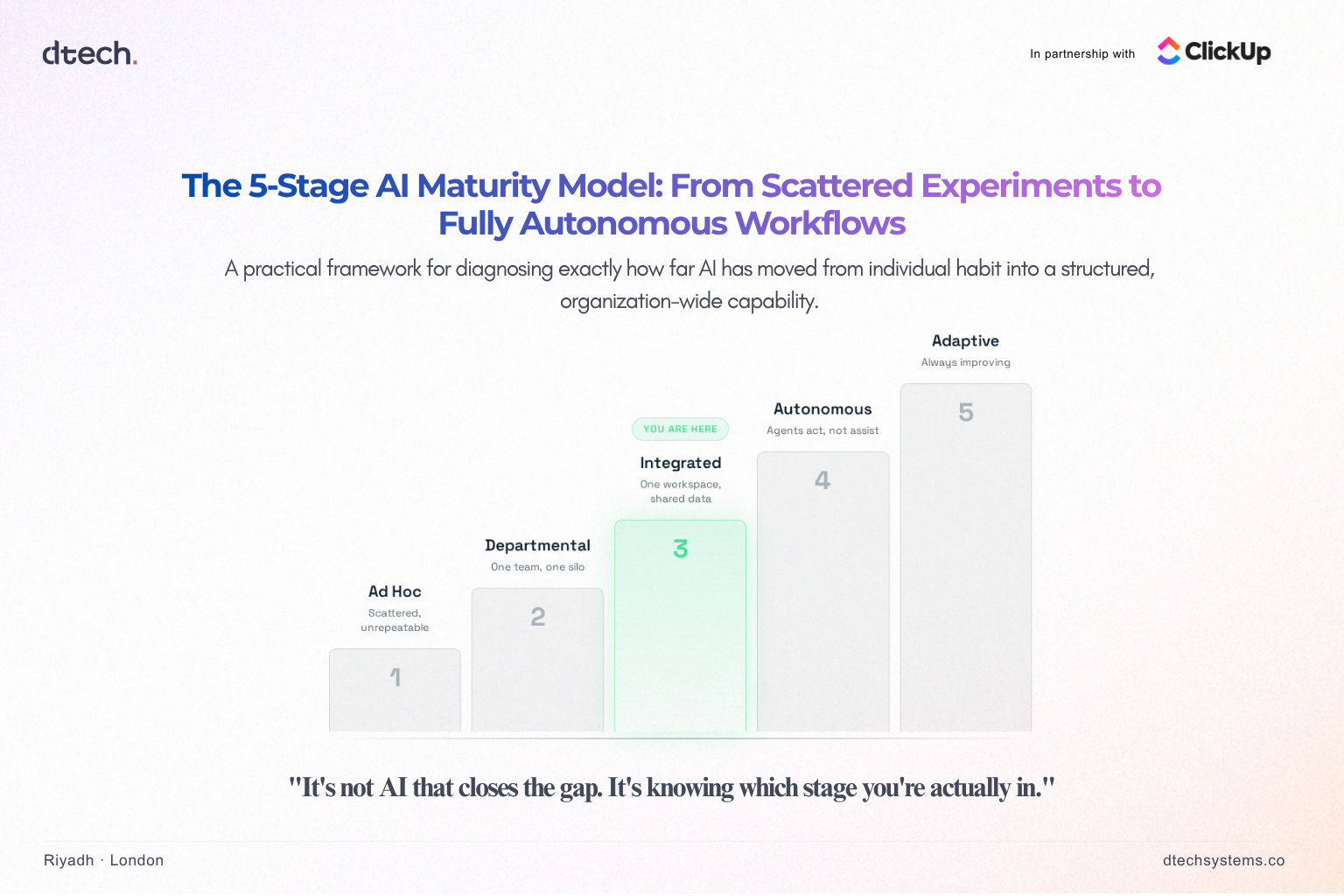
AI maturity model is the term more businesses should be searching before they buy another AI tool. Every company in Saudi Arabia now claims to be "doing AI." Few can tell you how much AI they're actually doing — or whether any of it is working.
That gap is the real problem. Not the tools. Not the budget. The gap between believing you've adopted AI and actually knowing where you stand.
This is exactly where an AI maturity model earns its keep. It's not a scorecard designed to make you feel behind. It's a mirror — one that shows you precisely which stage your workflows are in, and precisely what the next stage requires from you.
Why "Are We Using AI?" Is the Wrong Question
Most companies answer that question with a list of tools: a chatbot here, an AI writing assistant there, maybe a forecasting model tucked into finance. But tool count is a vanity metric. It tells you nothing about whether AI is actually changing how work gets done day to day.
The right question isn't "are we using AI." It's "how deeply is AI embedded in how our teams actually operate." That's a maturity question, not a checklist question — and answering it properly requires an AI maturity model, not a tool inventory.
What an AI Maturity Model Actually Measures
The Five Stages of AI Maturity
Stage 1: Ad Hoc AI shows up as individual experiments. Someone on the marketing team uses a chatbot to draft captions. Someone in sales uses AI to summarize a call. There's no strategy, no shared system, and no visibility for leadership into who's doing what. Value exists, but it's invisible and unrepeatable — which is precisely why a business at this stage needs an AI maturity model to make the gaps visible.
Stage 2: Departmental One team formalizes its use of AI — usually whichever team is under the most pressure to move fast. Marketing might standardize on an AI content tool. Support might roll out an AI ticket-triage flow. The results are real, but they live in a silo. Other departments don't know the system exists, let alone how to replicate it.
Stage 3: Integrated AI moves out of silos and into shared systems. This is the stage where the platform matters more than the tool, because integration requires a workspace where data, tasks, and AI outputs sit in one place instead of scattered across five apps. Teams start automating handoffs between each other, not just individual tasks within their own corner of the business.
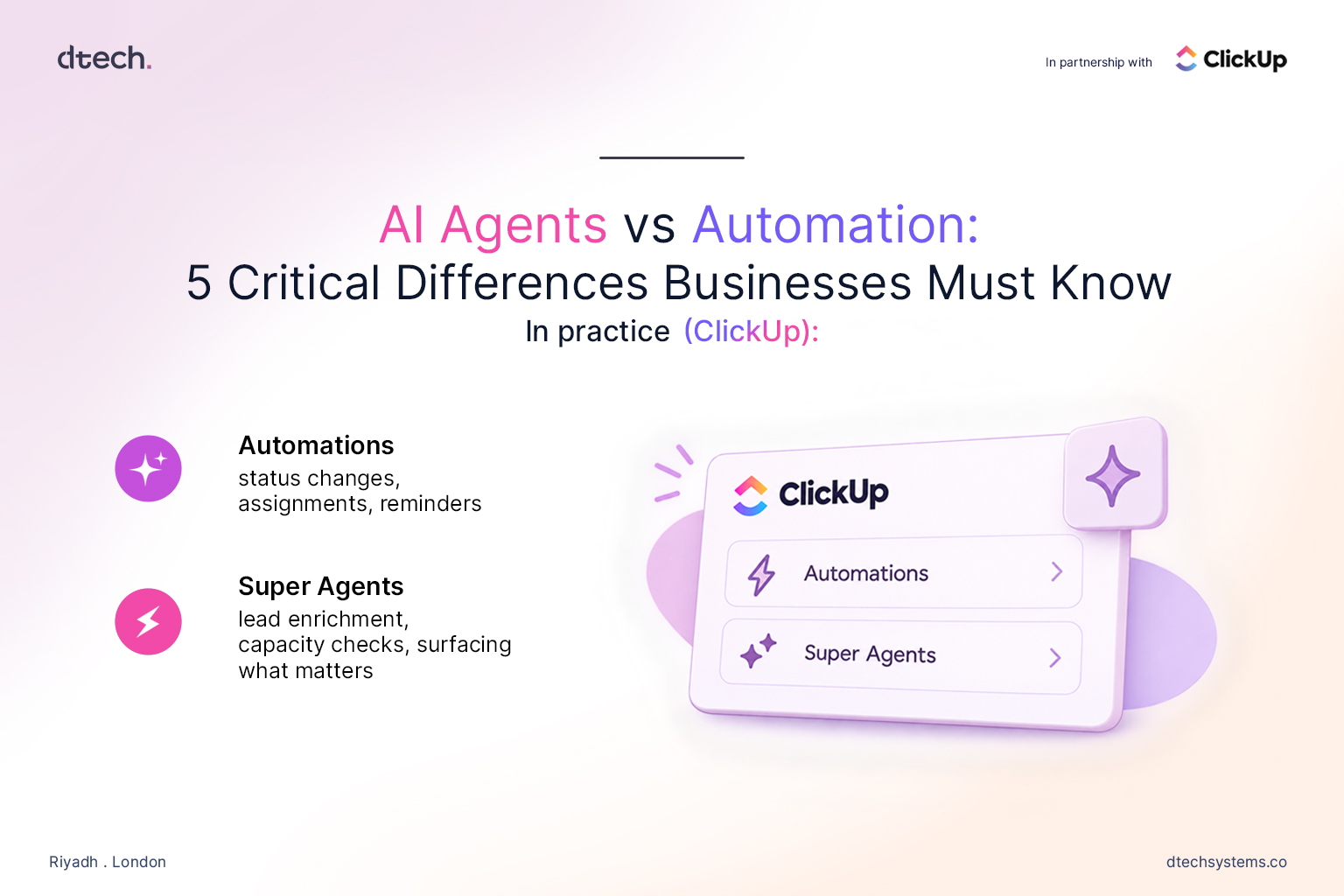
Stage 4: Autonomous AI agents start making decisions within defined boundaries — triaging incoming leads, reassigning overdue tasks, flagging risks before a human even notices them. This is where something like ClickUp's Autopilot Agents changes the equation: agents that act inside your existing workflow rather than requiring a new one bolted on the side.
Stage 5: Adaptive The organization treats AI maturity as a continuous capability, not a project with an end date. Workflows self-adjust based on outcomes. Leadership reviews AI performance the way it reviews revenue — as a standing metric, not a one-time initiative to check off.
Where Most Saudi Businesses Actually Sit
If we're honest, most organizations riding this year's AI wave — accelerated by Vision 2030's push toward digital-first operations — are sitting between Stage 1 and Stage 2 on the AI maturity model. Lots of individual experimentation. Very little integration. Almost no organizations have reached Stage 4, where AI acts rather than just assists.
That's not a criticism. It's the natural result of adopting tools faster than restructuring the workflows underneath them. But it does mean most companies are leaving the real value of AI — compounding efficiency, not one-off time savings — sitting on the table.
The Jump From Stage 2 to Stage 3 Is Where Businesses Get Stuck
This is the stage where tool sprawl becomes the enemy of progress — a pattern we broke down in Your Company Doesn't Need More AI Tools. It Needs Better Workflows. You can't integrate AI across departments when every department is using a different tool with no shared data layer underneath it. This is exactly the problem workflow platforms like ClickUp exist to solve: one system where tasks, docs, chat, and AI sit together, so AI outputs from one team become usable inputs for the next.
This is the stage where tool sprawl becomes the enemy of progress. You can't integrate AI across departments when every department is using a different tool with no shared data layer underneath it. This is exactly the problem workflow platforms like ClickUp exist to solve: one system where tasks, docs, chat, and AI sit together, so AI outputs from one team become usable inputs for the next.
Moving from Stage 2 to Stage 3 on the AI maturity model isn't about adding another AI tool. It's about consolidating the ones you already have into a system that lets them talk to each other.
How to Use an AI Maturity Model in Your Own Business
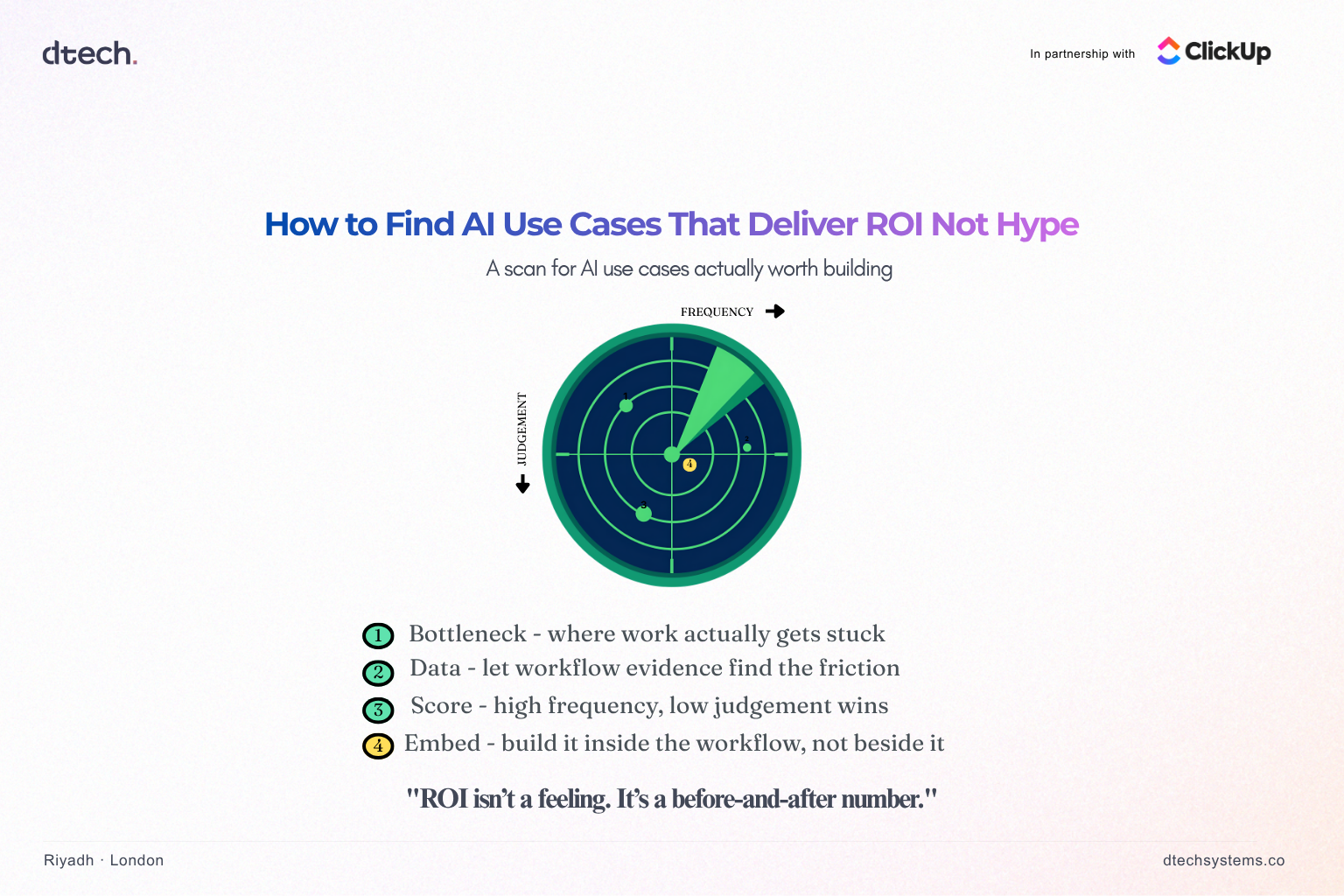
Applying an AI maturity model doesn't require a consultant on day one. Start by mapping, honestly, which stage each department sits in today — not where you'd like them to be. Then look for the biggest gap between departments; that gap is usually where the most value is being lost. Finally, pick one workflow to move up a full stage before spreading effort across ten. Maturity compounds fastest when it's concentrated, not scattered.
Assess Before You Automate
The businesses that get the most out of AI aren't the ones with the most tools. They're the ones who diagnosed their stage on the AI maturity model honestly before deciding what to build next. Skipping that step is how companies end up automating a broken process — and getting a faster version of the same problem.
If you don't know your stage, that's the first project. Not the AI rollout — the audit.
Dtech Systems helps businesses map their position on the AI maturity model and build the ClickUp workflows to move up it — not just adopt more tools