Embracing the Future: The Rapid Growth of Saudi Arabia’s Car Rental Industry
As time progresses, so does the dynamic landscape of our needs and preferences. We are currently navigating an era marked by rapid change and innovation. Nations around the globe are adapting to this evolving reality, and Saudi Arabia is at the forefront, fueled by its ambitious Vision 2030. This initiative has catalyzed significant transformations across the country, ushering in a new era of technological integration.
Delving into the car rental industry, we observe a similar trend of robust growth in Saudi Arabia, paralleled by global market expansions. This surge is driven primarily by a few key factors. Firstly, the kingdom has experienced a notable increase in tourism, partly due to eased visa regulations and enhanced global outreach initiatives. Furthermore, the rising disposable income among locals and their growing affinity for luxury experiences have significantly boosted the demand for high-end rental vehicles. This combination of factors is propelling the industry forward at an unprecedented pace.
Financial projections for the car rental market in Saudi Arabia are equally optimistic, reflecting the industry’s strong potential. By the year 2024, the market is expected to reach a valuation of approximately US$1.14 billion and is projected to grow at an annual rate of 2.33%, culminating in an estimated total of around US$1.25 billion by 2028. A pivotal element in this growth trajectory will be the role of online sales channels, which are anticipated to account for 61% of total revenue by 2028. This shift highlights the critical importance of digital platforms in the future of the car rental industry in the kingdom, aligning with global trends towards more technologically integrated service offerings.
The Major Players in KSA
In Saudi Arabia, the car rental industry showcases a mix of global giants and dynamic local players, all of whom are increasingly adopting innovative technologies to enhance customer experience and operational efficiency. Below is a detailed overview of the primary entities shaping this rapidly evolving market:
In a seemingly saturated market, the entry of new players might appear unfavorable at first glance. However, the robust market figures detailed earlier contradict this notion, demonstrating that there is still ample opportunity for growth and innovation. It is crucial for newcomers to recognize that in order to differentiate themselves and thrive in this competitive landscape, leveraging an online platform is not just an advantage—it’s a necessity. The current market dynamics show that without a strong digital presence, any new entrant risks being overshadowed by established players who are already capitalizing on the efficiencies and expanded reach that technology provides.
Dtech’s Journey in Developing a Car Rental App for the Saudi Market:
At Dtech, our experience with clients across Saudi Arabia has often steered us towards creating innovative travel-related products. One notable venture was the development of ROWW, a sophisticated mobile app designed specifically for car rentals.
Initiating the Project
The project kicked off in 2020, targeting the Saudi market. Our challenge was to harness the power of technology to deliver tangible value to our customers. As we ventured into this project, our strategy involved detailed market research and collaborative discussions with stakeholders. Our goal was to craft an app that not only met but exceeded the functionalities of established apps like Turo.
Building the MVP
The Minimum Viable Product (MVP) we developed was structured around key automation features and robust policies to safeguard both renters and hosts. We introduced a comprehensive cancellation policy that facilitated automatic refunds, which aimed at enhancing user trust and convenience. The app was equipped to automate critical aspects such as vehicle images, odometer readings, and extra charges for mileage overruns and accidents. Additionally, stringent verification processes were put in place requiring hosts to submit essential documents including insurance, license, and company credentials. This foundation was meticulously laid out to ensure readiness for launch.
Challenges at Beta Launch
Despite the meticulous preparation, the beta launch illuminated several unexpected challenges. We discovered that local companies, predominantly accustomed to traditional operational methods, were apprehensive about adopting new technological processes. The mandatory verification steps and booking conditions, though designed to protect all parties, were met with hesitance. Feedback indicated a preference for a more streamlined online marketplace that directly connected them to customers, prioritizing simplicity and ease of use over complex features.
Adapting to Market Needs
This feedback was invaluable as it highlighted the need for adjustments to better align the app with local business practices and customer expectations. The focus shifted towards simplifying the user journey to offer a seamless and direct marketplace experience, removing barriers and enhancing user engagement.
This journey underscores the complexities of introducing technology in traditionally conservative sectors. It illustrates the importance of flexibility and responsive adaptation in the development process to effectively meet market demands while fostering technological advancement.
A Strategic Pivot in Our Journey:
As we navigated through the development of ROWW, our innovative car rental app tailored for the Saudi market, we encountered the need for significant strategic reevaluation and refinement. Our goal was clear: to simplify the app’s functionality without compromising the robust technology that powers it.
Enhancing Payment Technologies
We prioritized maintaining an automated, secure, and efficient payment system. For ROWW, we chose HyperPay, a popular payment gateway recognized for its robust features tailored to the Saudi market. Key features include:
Support for Apple Pay, Mada, and Visa: Offering diverse payment options catered to user preferences.
Pre-authorization of Payments: This feature holds a payment before automatically deducting it once specified criteria are met, adding a layer of transactional security and trust.
Automatic Refunds for Cancellations and Booking Rejections: Ensuring a smooth, worry-free booking experience for users.
The selection of HyperPay was crucial not just for its functionality but also for fostering a secure environment for financial transactions, which is vital in the transition to a cashless society. This capability significantly benefits both local users and tourists by accommodating easy pre-booking options from around the globe, simplifying currency conversions and time zone adjustments.
User Journey and Interface Enhancements
Feedback from our beta testing phase was invaluable, leading to several user-focused adjustments in the app:
Streamlined Login/Registration: Understanding user preferences helped us implement more convenient login options such as Apple and Google login, alongside mobile number access with OTP authentication.
Advanced Filtering and Sorting: To enhance the user’s ability to find the perfect vehicle, we introduced multiple new filtering options:
– Search by company, location, or booking period.
– Offers and discounts, vehicle delivery availability.
– Vehicle type and sorting options like price, distance, rating, and relevance.
Marketing and Promotions:
To effectively penetrate the market, we recognized the importance of promotional strategies. We integrated promo code functionalities, enabling both hosts to offer discounts and ROWW to run promotional campaigns, thereby driving user engagement and adoption.
Future Trends and Innovations in Saudi Car Rentals
While our initial experience revealed that the market was somewhat resistant to adopting a fully tech-savvy app, it is evident that the trajectory of the Saudi market is increasingly leaning towards greater technological integration. The rise and integration of AI technology are inevitable and set to play a crucial role in differentiating offerings in a competitive landscape.
AI can be leveraged in several impactful ways:
1. Predictive Suggestions: Utilizing advanced AI algorithms, car rental businesses can enhance their service offering by providing personalized vehicle recommendations. These suggestions can be tailored based on a combination of factors, including a customer’s previous rental choices, specific travel needs, and preferences indicated through social media interactions. This predictive ability not only improves user experience but also boosts customer loyalty and satisfaction.
2. Automated Customer Service: AI-driven chatbots and virtual assistants can revolutionize customer interactions by providing 24/7 support. These systems can handle a broad spectrum of customer service tasks, from managing bookings and answering FAQs to resolving issues and gathering feedback, all in real-time.
3. Enhanced Vehicle Imagery: AI can also be utilized to improve the presentation of rental vehicles online. By using high-quality, AI-enhanced images that provide potential renters with realistic, detailed visuals of the cars, rental companies can significantly enhance online engagement and trust.
Such innovations will not only prepare the Saudi car rental market for future technological advancements but also ensure that businesses remain competitive and relevant in an evolving industry landscape. As Saudi Arabia progresses towards a more digitally integrated economy, embracing these AI capabilities will be key to staying ahead in the competitive curve.
Comparison: Traditional Car Rental Solutions vs. An Innovative Approach
There is no doubt that companies leveraging online solutions like apps, web portals, and websites have a clear competitive edge. Currently, having an online presence with basic features provides a significant advantage. However, as the market evolves, even this will no longer suffice. Companies will need to integrate AI and advanced technologies to stay ahead of the curve.
How do contemporary firms compare to traditional car rental solutions? Here’s a comparison to illustrate why partnering with Dtech for your digital transformation can be a game-changer.
Aspect
Traditional Car Rental Solutions
Dtech’s Innovative Approach
Benefits of leveraging Technology
User Experience
Manual booking processes, long wait times.
Seamless, app-based booking with instant confirmations.
Faster, more convenient bookings, improved customer satisfaction.
If you’re considering entering the rental market, don’t hesitate to book a consultation with our experts to strategize your next steps effectively.
This recalibrated approach emphasizes our commitment to optimizing the car rental experience through continuous innovation and user feedback, ensuring ROWW not only meets but exceeds market expectations.
Streamline Your Growth by Outsourcing Your Developers
In today’s rapidly evolving digital landscape, businesses must innovate and scale swiftly to stay competitive. One of the most effective strategies to achieve this is by outsourcing your developers. Outsourcing isn’t just a cost-cutting measure; it’s a strategic approach that can drive your company’s growth and streamline operations. Let’s delve into how outsourcing can be a game-changer for your business.
1. Access to a Global Talent Pool
Outsourcing opens the doors to a global marketplace of developers with diverse skill sets and experiences. This allows you to:
Find the Right Expertise: Whether you need specialists in AI, blockchain, mobile app development, or any other niche, outsourcing enables you to find experts tailored to your project’s specific needs. This diversity in expertise can bring innovative solutions and a
competitive edge to your projects.
Innovative Solutions: Different backgrounds and experiences bring fresh perspectives, fostering innovation and creative problem-solving. A global talent pool means you’re not limited to local resources and can tap into the latest trends and technologies worldwide.
2. Cost Efficiency
Hiring full-time, in-house developers can be costly, especially when you factor in salaries, benefits, office space, and equipment. Outsourcing offers:
Reduced Overheads: You pay for the services you need without the additional overhead costs. This can significantly lower your development expenses while maintaining high quality.
Flexible Pricing Models: Choose from hourly rates, fixed-price contracts, or retainer agreements based on your budget and project scope. This flexibility allows you to manage your finances more effectively and allocate resources where they are needed most.
3. Scalability and Flexibility
Business needs can fluctuate, and outsourcing provides the flexibility to scale your development team up or down as needed. This ensures you can:
Adapt Quickly: Respond to market changes or project demands without the delays associated with hiring and training new staff. This agility is crucial in a fast-paced business environment where timing can make a significant difference.
Focus on Core Competencies: Allow your in-house team to concentrate on core business functions while outsourced developers handle specialized tasks. This division of labor ensures that your internal team can work on strategic initiatives without being bogged down by routine development work.
4. Faster Time-to-Market
In the competitive tech industry, speed is crucial. Outsourcing can accelerate your project timelines by:
Leveraging Time Zones: Take advantage of different time zones to enable round-the-clock development. By having a team working on your project around the clock, you can significantly reduce the time required to bring a product to market.
Access to Established Processes: Many outsourcing firms have refined their workflows to be highly efficient, ensuring quicker project completions. These established processes mean you can benefit from their experience and get your product out faster.
5. Risk Mitigation
Outsourcing can help mitigate various risks associated with development projects:
Expertise in Compliance: Partner with developers who are well-versed in industry regulations and standards, ensuring your project meets all necessary compliance requirements. This can protect you from legal and regulatory issues that could arise from non-compliance.
Shared Responsibility: Spread the risk by collaborating with experienced firms that can anticipate and manage potential issues. Outsourcing firms often have robust risk management practices in place, providing an extra layer of security for your projects.
6. Focus on Innovation
Outsourcing routine development tasks allows your in-house team to focus on strategic initiatives and innovation. This shift can:
Enhance Product Quality: By dedicating more time to R&D and less to day-to-day coding, your team can develop higher-quality products. Innovation-driven companies often lead the market by continuously improving and evolving their offerings.
Drive Business Growth: Innovate and implement new ideas that can propel your business forward. By freeing up your in-house team to focus on growth-oriented tasks, you can explore new business opportunities and expand your market reach.
How to Choose the Right Outsourcing Partner
To maximize the benefits of outsourcing, it’s crucial to choose the right partner. Here are some tips:
Evaluate Experience and Expertise: Look for firms with a proven track record in your industry and the specific technologies you require. Check their portfolio and case studies to see the types of projects they’ve successfully completed.
Check References and Reviews: Assess past client experiences to gauge reliability and quality of work. Client testimonials and reviews can provide valuable insights into the firm’s performance and client satisfaction.
Communication and Culture Fit: Ensure the outsourcing team communicates effectively and aligns with your company’s culture and values. Good communication is key to successful collaboration, and a cultural fit ensures smoother interactions and better understanding.
Security and Confidentiality: Verify that the firm follows stringent security measures to protect your intellectual property and data. Ensure they have robust data protection policies and practices in place to safeguard your sensitive information.
Conclusion
Outsourcing your developers can be a transformative strategy for your business, offering access to top talent, cost savings, flexibility, and faster innovation. By strategically partnering with the right outsourcing firm, you can streamline your growth, focus on core business functions, and stay ahead in the competitive market. Embrace the future of work by leveraging the global talent pool and unlock your company’s full potential.
Ready to take the leap? Start exploring outsourcing options today and watch your business soar to new heights. The world is your talent pool, and by harnessing its potential, you can achieve unprecedented growth and success.
Remember the days of drowning in sticky notes, battling overflowing inboxes, and facing the dreaded “status report” meeting? Those days are officially over, thanks to the combined future-force of Artificial Intelligence (AI) and ClickUp, the project management superhero!
DTechSystems is excited to announce we’re now offering cutting-edge solutions that leverage the power of AI and ClickUp to transform your project management game!
Here’s a sneak peek at the magic we can unleash for you:
AI-powered Workflows: Imagine having a virtual project assistant that anticipates your needs! AI will analyze your workflows, identify repetitive tasks, and suggest ClickUp automations to streamline your entire process. Say goodbye to tedious manual work and hello to laser-focused efficiency!
Smarter Resource Allocation: Tired of playing resource management roulette? AI can analyze team skillsets, workload, and project deadlines to ensure the right talent is assigned to the right tasks at the right time. No more bottlenecks, just smooth sailing towards project success!
Predictive Analytics: Gain the power of foresight! AI will analyze historical data to predict potential roadblocks and resource constraints before they arise. This proactive approach allows you to make informed decisions and course-correct before issues derail your projects.
But wait, there’s more! DTechSystems doesn’t just hand you a shiny new ClickUp with AI sprinkles. We’re your one-stop shop for project management transformation:
Expert ClickUp Configuration: Our ClickUp gurus will tailor AI-powered automations to your specific needs and workflows. No generic, one-size-fits-all solutions here! ♀️
Seamless Integration: We’ll ensure a smooth integration of AI with your existing ClickUp setup, minimizing disruption and maximizing efficiency.
Ongoing Support: The world of AI and ClickUp is constantly evolving. Our team stays ahead of the curve, ensuring your automations remain optimized and effective.
Ready to ditch the project management struggle and embrace the future?
Contact DTechSystems today for a free consultation! Let’s discuss how we can leverage the power of AI and ClickUp to propel your projects to new heights of success!
P.S. Have questions about AI-powered project management? Leave a comment below, and let’s chat about how we can help you navigate the exciting future of work!
Ah, project management – the Bermuda Triangle of productivity. Remember the good old days? Drowning in sticky notes, chasing down updates via email avalanches, and facing the dreaded “status report” meeting – a breeding ground for anxieties and missed deadlines.
We, at DTechSystems, know this struggle all too well. We’ve been there, battling the project management beast with traditional methods. Then, a beacon of hope emerged: ClickUp.
It wasn’t magic (although sometimes it felt like it). It was automation. ClickUp’s built-in automation features became our secret weapon, transforming project management from a chaotic battlefield to a symphony of streamlined efficiency.
The Executive Escape:
Imagine a world where executives can ditch the micromanagement and focus on strategic decisions. ClickUp automations made this a reality. Automated reports and progress notifications painted a clear picture of project health, freeing up valuable time for executives to steer the ship, not get caught in the daily weeds.
The Project Manager’s Ascension:
From task-drowning drudgery to workflow maestro – ClickUp automations empowered project managers like never before. Repetitive tasks like assigning duties, setting deadlines, and managing dependencies became automated spells, banishing the administrative burden. Project managers were finally free to focus on what truly mattered: guiding their teams to project victory.
Team Zen achieved:
The constant barrage of notifications, the struggle to stay on top of ever-changing tasks – these were the daily demons plaguing team members. ClickUp automations cast a calming spell. Automated notifications and task updates became personalized whispers, keeping everyone focused and informed without the information overload.
But here’s the secret sauce:
Unlike AI-based solutions, ClickUp automations aren’t a black box. We, the DTechSystems ClickUp wizards, wield the power of customization. We craft automations that perfectly align with your unique workflows, ensuring they work for you, not against you.
Our expertise doesn’t stop there. We’re workflow alchemists, identifying bottlenecks and streamlining processes. Your automations become living, breathing entities – constantly optimized and effective with our ongoing support.
Are you ready to escape the project management Bermuda Triangle? ClickUp offers a powerful platform, but DTechSystems unlocks its full potential. Contact us today and let our ClickUp gurus craft custom automations that will transform your project management from chaotic struggle to a symphony of success.
P.S. Still have questions about ClickUp automations? Leave a comment below, and let’s chat about your project management journey!
Project management is the spine of a successful business. The choice of project management tools is vital nowadays as firms seek ways to improve efficiency and achieve success. Nowadays, in an era of cooperation, it is important to identify a tool that effectively coordinates assignments and at the same time develops communication.
A notable example of emerging platforms in the project management field is ClickUp. As a product development company in this post, we will dive into the ClickUp domain revealing what it entails, its advantages, and how the future of project management is being shaped by this software.
Understanding ClickUp as a Project Management Tool:
ClickUp features such as task management, collaborating tools, goal tracking, or connectivity with other vital enterprise applications demonstrate its flexibility. ClickUp can serve any company–from a small startup, that needs organized workflow, to a big enterprise that seeks efficiency and is ready to apply innovations.
ClickUp is a unique, not just another, project management software.
It is developed specifically for serving diverse business needs in daily operations.
ClickUp provides functionalities for hassle-free task management.
It fosters collaboration among team members.
Acts as a central hub for all project operations.
Features a user-friendly interface for easy onboarding and use.
Suitable and workable even for small business entities.
Key Benefits of ClickUp:
The adoption of ClickUp brings forth a multitude of benefits for businesses aiming to optimize their project management processes.
1. Increased Productivity and Efficiency:
The efficient communication and task automation offered by ClickUp plays a significant role in greater productivity. It also allows users not to keep messaging each other over and over again through emails as communication is centralized in tasks. Automation enables the processing of routine actions smoothly while giving space for the team to deal with significant tasks.
2. Improved Collaboration:
Close collaboration is a key element of successful ClickUp project management. As teams collaborate on different tasks, they get to share documents among themselves and use the built-in chat system in ClickUp. It makes teamwork easier and reduces the chances of mistakes while communicating errors.
3. Real-time Tracking and Reporting:
ClickUp has another distinct advantage in that it provides live metrics on project success probability. Customized dashboards and reporting provide that businesses can monitor critical data points guiding their decisions to a specific insight. Transparency also makes everyone aware, that one can adapt fast whenever there is a need.
4. Enhanced Project Transparency:
Tracking progress is not the only thing that indicates ClickUp’s transparency. The said platform makes it possible to see all parties involved in the project when deadlines are expected, what are the requirements to complete various tasks, and how resources are allocated. It creates transparency which is crucial for ensuring compliance and revealing early on any potential bottlenecks that may blow out of proportion.
The Future of Project Management with ClickUp:
As businesses evolve, so do the trends in project management. ClickUp is at the forefront of shaping the future of project management by adapting to these evolving trends.
a. Evolving Trends in Project Management:
The project management landscape is always dynamic with trends coming in. Businesses have shifted from reliance on remote work to integrating artificial intelligence into their operations. Regular updates and commitment to innovations by ClickUp conform to these trends which make it possible for the users constantly to have access to up-to-date features.
b. ClickUp’s Role in Shaping the Future:
ClickUp is not just a tool of the present but it can be classified as a future investment. Additionally, its flexible nature enables it to grow along with businesses as more functionalities and integrations are introduced into the platform. ClickUp continues to support organizations with changes in project management trends that enable them to meet the demands of their stakeholders.
c. Potential Updates and Features:
The team behind the platform constantly seeks user feedback and develops updates that deal with true real-world challenges. In terms of integration and analytics, ClickUp is always a step ahead.
ClickUp Implementation Strategies:
Adopting ClickUp into your business requires a strategic approach to ensure a smooth transition and maximum utilization of its features.
1. Steps to Successfully Implement ClickUp:
The first step in implementing ClickUp is knowing what your business procedures are. Carry out a needs assessment of key stakeholders, hold an intensive training period, and create effective communication links. While an intuitive interface of ClickUp helps ease the onboarding process, a proper roll-out plan guarantees a smooth transition.
2. Tips for Onboarding and Training:
ClickUp’s successful integration requires proper onboarding, as well as effective training from ClickUp experts. ClickUp specialists prepare manuals, participate in practice sessions, and inculcate a spirit of life-long learning. In addition, its intensive knowledge base and available customer support also help people to navigate their way through the onboarding process successfully.
3. Common Challenges and How to Overcome Them:
Although ClickUp eases on managing projects there may be difficulties while using it initially. Some of these difficulties could include change resistance, data transfer problems, or the necessity for bespoke integrations. ClickUp Consultancy with a strong support system, constant communication, and being proactive in addressing these challenges will lead to success.
Conclusion:
ClickUp is revealed as a revolutionary factor in project management. Easy-to-use interface and a wide variety of options including an innovative approach make it a trusted ally for any company willing to improve its project management.
With time project management trends continue changing; therefore, ClickUp has come on top of others by changing how companies organize, collaborate, and reach their goals Do not think of ClickUp only for today, but as an equity that will guarantee tomorrow’s success of every business. Dtech Systems can be your true ClickUp consultant to help you navigate this maze.
FAQs Related to ClickUp:
Is ClickUp Better Than Asana?
Both ClickUp and Asana are popular project management systems but have different features. Therefore, choosing between ClickUp and Asana will be dependent on particular company needs. Though ClickUp is rich in features and comes with better functionality.
What Apps Can ClickUp Replace?
Integration with other business tools is also offered by ClickUp. It can/ replace or become an addition to applications such as Slack, Google Drive, Zoom, and many more. It aims to reduce the effort in workflows through consolidation of the tasks and communication. Businesses should consider the current apps they operate on, and determine whether ClickUp will properly function with all the necessary instruments.
What Big Companies Use ClickUp?
The range of users that ClickUp has includes small businesses as well as large organizations. The use of ClickUp is noteworthy in such big brands as Airbnb, Google, and Uber. Using ClickUp, these other companies enhance their collaboration; make the projects more visible; and increase general productivity within organizations.
Establishing a tech startup can be overwhelming if you don’t know much about technology and the technical aspects of a startup. Consequently, this leaves most entrepreneurs feeling as if they shouldn’t be out there on the playing field.
In this blog, as a product development company, we will discuss the unique challenges encountered by non-technical founders and preferred workable solutions for them ranging from the ideation phase to scaling.
Understanding Your Strengths and Weaknesses
A. Assessing your skills and expertise
Self-evaluation is a significant factor for a non-technical founder. Know what you are good at – you may be an amazing marketer, excellent salesman, incredible designer, born-to-lead type of person, etc. Identify your weak spot and in particular the technical area. Taking note of your abilities gives you a position to utilize them well during the start-up venture’s process.
B. Recognizing the importance of a balanced team
Startup success thrives on diversity. Do not only see a balanced team in terms of technical and non-technical skills but also diverse aspects such as perspectives, backgrounds, and approaches. Creativity, the ability to resolve a problem, and resiliency, all these are born when a team has different strengths. Harness the strength of various brains coordinating towards tackling start-up issues.
C. Building a complementary team to fill technical gaps
Look out for co-founders and other team members who know their technology, development, and code well enough for them. Apart from this, it helps to bridge the technical gap as well as fosters team spirit with different skills which moves the startup forward. This enables them to create a balanced team that can look at all sides and face challenges from various places.
Identifying and Validating Your Idea
A. The role of market research in idea generation
A successful startup is built on market research. Explore your competitive environment to understand current issues, fads, and market trends. Analyze the current situation of the markets to find inadequacies and prospects. The creation of new ideas in a startup is not complete without first conducting a thorough market analysis.
B. Leveraging your industry knowledge
Use your inside information to discover issues that other people would miss. Rely on your business knowledge to grasp the complexity of the sector, spot upcoming innovations as well and predict imminent requirements. You can come up with revolutionary concepts that can appeal to your intended listeners because of this in-depth knowledge.
C. Techniques for validating your startup concept without technical expertise
Surveys and Interviews: Conduct surveys and interviews to engage with your target audience. Ask them their pain points, what they like or dislike, and if they are willing to try a new method. The analysis of their response gives ideas about the market’s desire for your idea.
Prototyping Tools: Create a visual representation (prototype) of your idea using prototyping tools. You can present your ideas in a real way to possible consumers and investors so as to receive an evaluation of their usefulness and attractiveness.
MVP Testing: Create an MVP with basic features that are easy to comprehend for non-techies. Start with launching it to a small audience so as to get some initial feedback on user flow and overall product usability. This real-world testing assists you in proving that your concept is relevant and applicable.
Building a Network and Finding Co-Founders
A. Networking in the startup ecosystem
Attend Events and Conferences: Attend local and remote startup events, conferences, and gatherings. They offer chances for people of similar opinion, collaborators, and investors to meet up together. Meet people, tell them about yourself and your business ideas, and develop relationships with other startups.
Online Platforms: Startup-focused online platforms as well as forums can help you connect with related peers. Join groups of discussions, reveal your vision as a startup owner, and involve yourself in communication with those who have similar ideas.
Incubators and Accelerators: Try associating with startups in incubators and accelerators. These are programs that help in the provision of useful materials and mentorship and also present a networking platform for other entrepreneurs, financiers, and players in the industry.
B. The value of mentorship in navigating the startup landscape
Access to Experience: A mentor should have substantial experience that can guide you as you try out your ideas in establishing a business venture. They will assist you on a faster-paced learning curve by giving you advice from their experiences.
Networking Opportunities: Most of the time, mentors’ are connected with an enormous number of people in the field. Through their introductions and recommendations, they can create a platform for partnership with such investors and others of significance who will help you make your start-up.
Accountability and Support: Mentorship is also crucial as it gives the individual an additional sense of accountability and emotional support. Moreover, they will keep you focused on set objectives, encourage you when it gets hard, and make appropriate comments that would assist in your choices.
Continuous Learning: Mentorship is a continuous educational activity. As such, you pick up new ideas and observe industry dynamics before acquiring essential survival skills for the world of startups.
Creating a Minimum Viable Product (MVP)
A. Understanding the concept of MVP
A vital idea during start-up generation is a minimum viable product (MVP). It entails developing only minimum features on your product sufficient for early users. This is to collect responses, confirm hypotheses, and limit the wastage of resources. For this reason, it is important that the non-technical founders realize what an MVP means in order to shorten the process of developing products for them, and not waste financial resources.
B. Collaborating with developers to bring your MVP to life
Development of a working product and collaboration with developers are crucial steps for transforming your MVP idea into a real working entity. Here’s how non-technical founders can effectively collaborate:
Clearly Define Requirements:
Make sure you define, in a clear manner, your MVP’s requirements based on each functionality as well as, user stories. It offers developers an idea about what they are expected to cover in the project.
Choose the Right Development Team:
Choose one development team that is compatible with your startup’s objectives and who has the requisite experience for your business. Look at things like experience, ability to communicate, etc., and see if they fit into your company’s culture.
Utilize Project Management Tools:
Use project management systems such as Jira, Trello, or Asana for better information sharing and teamwork. The use of these tools also enables them to track progress, manage various tasks, and ensure that everyone is notified.
Regular Check-ins and Feedback Loops:
Hold periodic meetings to talk about achievements, difficulties, and suggestions. Setting up a feedback loop will make sure that the progress is in line with your idea while the required amendments occur immediately.
Test and Iterate:
Test the MVP and get feedback from users. Partner with developers to iterate on the version of the product based on feedback from users and keep improving it.
Conclusion
Lack of technical background doesn’t hinder your capacity to develop and expand a startup. Your other skills and expertise can prove to be more helpful in this regard. Accept the challenges and embrace the setbacks whilst celebrating each little victory along the way. Always bear in mind that all forms of innovation thrive beyond technological barriers in a startup world.
FAQs Related to Starting a Tech Business
As a non-technical founder, how do I validate my startup idea without technical expertise?
Endeavor in market research and emphasize specific knowledge of your particular industry. Conduct surveys, interviews, or prototype testing. Talk to possible users and get opinions about whether or not the idea really is the right answer to the problem.
What are the key skills non-technical founders should develop for startup success?
Develop the skills of communicating effectively, networking, and thinking strategically. Knowledge of elementary technical ideas will do; the focus should be on expanding abilities and creating a compatible team.
How can non-technical founders find suitable technical co-founders?
Network at meetups or attend startup communities as well as some start with social media marketing tools. Make sure you know what you want, then go for people who have the same passion. Co-founder dating events and mentoring are not to be overlooked among other useful networking opportunities.
Is it possible to create a Minimum Viable Product (MVP) without technical skills?
Definitely use prototyping in a no-code/low-code way for your idea. Work with freelancers or development agencies on the technical front. Ensure that your MVP is simple and focuses on functionality as this will let you express your idea without too many technical niceties.
How can non-technical founders navigate fundraising without technical jargon?
Develop an interesting and non-technical statement that is focused on the problem addressed and the associated market opportunity. Let your images and stories express what you see. Establish strong ties with investors who grasp your field of specialization, and view your views as different but equally valuable.
Developing an ideal MVP in 2023 can be as complicated as exploring blindfolded in a labyrinth. However, do not worry; we are behind you. We know the struggle of building an MVP – juggling between function/design, usability, and affordability barriers.
In this blog, we serve you with the best tips to guide you in cutting through the clatter and creating a viable MVP that appeals to your target market. Everything from pinpointing the essential attributes to locating an adequate development team is in our court.
Tips to Build the Right MVP in 2023
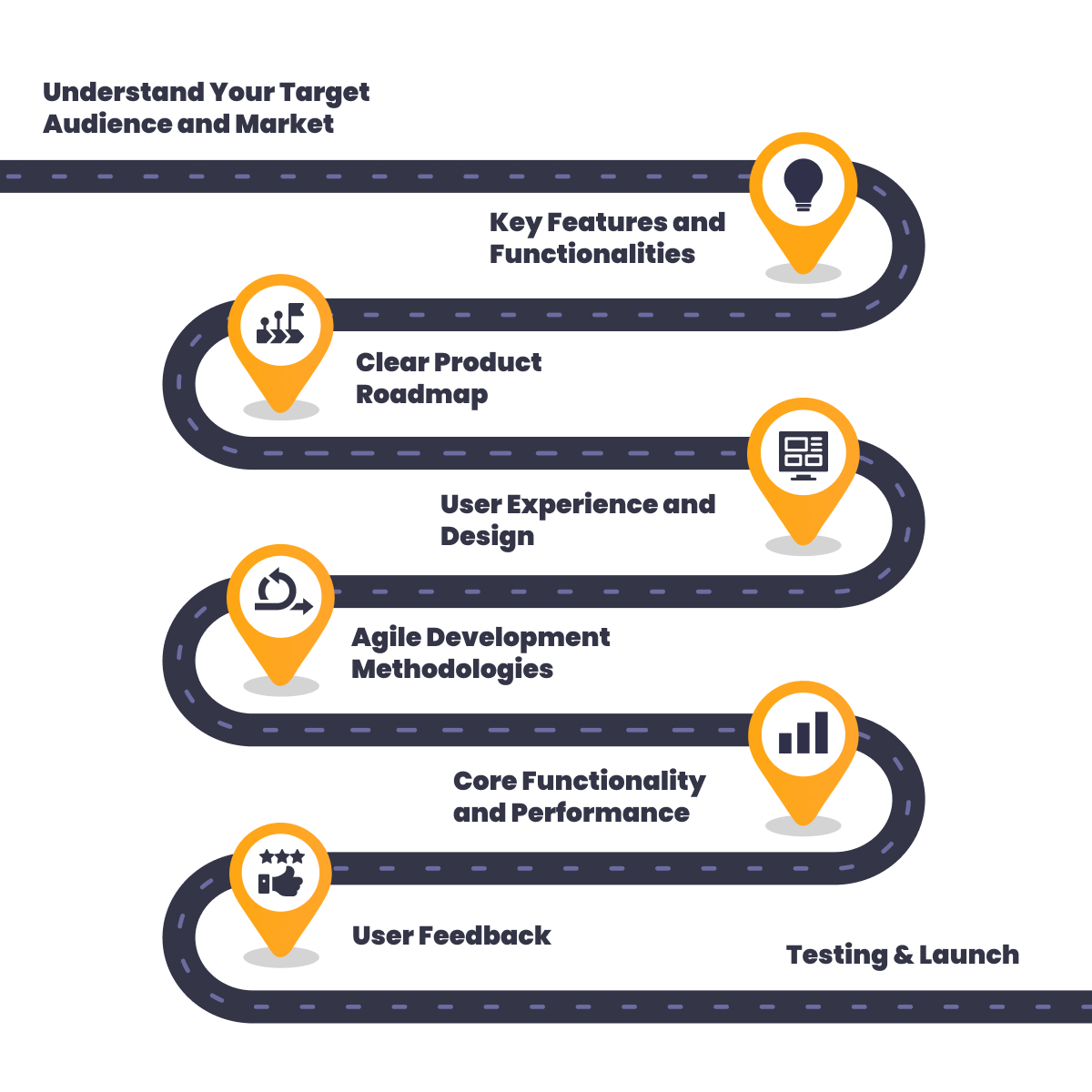
Understand Your Target Audience and Market
It is important to ensure that you undertake thorough research about the market before going into MVP development. Carry out intensive marketing studies to determine popular trends, customers’ problems, as well as possible rivals.
Describe who is your ideal customer or prospect; demographics, preferences, etc. You will use this knowledge to determine which features to include in your MVP so that they address a genuine problem.
Prioritize Key Features and Functionalities
Not all features are equal. The focus should be on what functions are fundamental and will benefit the end user most. Start with identifying the necessary characteristics of your MVP that are consistent with the central goal.
Identify “must-haves” features and the “add-on” features which can be included in further iterations. It makes sure that all resources are concentrated in a specific area.
Create a Clear Product Roadmap
The roadmap forms a guide that helps you during the product development process. It includes a roadmap of phases, milestones, and objectives from the inception of MVP through to market release. Design a development process consisting of small sprints, each of which has deliverables.
The roadmap allows one to have access to resources, set practical deadlines, and keep track of advancement on the way to obtaining an MVP product.
Build a Strong Development Team or Partner
It is vital to select, in this instance, a suitable development team or a partner for the construction of your MVP. Assess the costs involved, the talent required, and the project’s magnitude and determine whether to develop an in-house squad or outsource for the development.
Choose competent and credible developers or firms that have successfully launched an MVP before. It is crucial for effective communication and collaborative activities leading towards development success.
Emphasize User Experience and Design
A good user experience has become a vital component for any successful MVP. Ensure you come up with a clear, simple, and easy-to-follow user interface that will take customers through the product.
We conduct usability testing in order to collect early opinions and amend them as required. Ensure the MVP is easy to use by people with different needs. The basis of positive user engagement and adoption is a great UX.
Implement Agile Development Methodologies
Flexibility also entails using agile methodologies like Scrum and Kanban that allow open communication among all team members during their development processes. Divide the project into mini-projects that are shorter than two to four weeks for each Sprint.
Reassess objectives often, modify according to feedback, and amend priorities of features regularly as necessary. By employing an iterative approach, the MVP can continue to adjust to the changing requirements of users and dynamics in the markets.
Focus on Core Functionality and Performance
A smooth implementation of the core functions is key to MVP’s success. Make sure that the core purpose of the product is achieved perfectly. For optimum performance, responsiveness, and reliability. Fix major bugs and problems swiftly, in order to avoid inconveniencing users. First, make sure that you prioritize stability in order to create confidence and trust among your first users.
Gather and Incorporate User Feedback
Feedback from users is a treasure chest of ideas that can be used to improve the MVP’s quality. Carry out beta testing in a small group of users for more realistic input. Additionally, perform some surveys, user interviews, and data analysis to understand the users’ behavior and preferences thoroughly. To integrate improvements on a continuous basis.
Plan for Scalability and Future Growth
Identify potential scaling issues while developing your MVP. Develop a flexible infrastructure that will be able to cope with additional traffic and prospective functionality accession. Explore growth potentials and new functions appropriate for the future outlook.
Therefore, it is important to monitor system performance on a regular basis to ensure you are ready for any upcoming scalability issues with the increasing number of users.
Test, Test, Test!
A successful MVP launch relies on extensive testing. Carry out thorough testing on functionality, compatibility, and security. Carry out stress tests to be sure the system remains stable when it has a heavy load.
Carefully examine the MVP for a variety of specific scenarios and use cases. Identify any potential problems and correct them before releasing the product into the market for a smooth-running system.
Launch and Iterate
Now that the basis is secure, you can unveil your MVP.G Start with a managed rollout, targeted group of people, or specific sector. User monitoring, collecting authentic data about users, and receiving relevant information.
Make use of these insights to guide your next moves. Adopt an iterative attitude whereby you make intelligent choices related to subsequent iterations taking into account the reality of individual user experience as well as dynamism in market trends.
Conclusion
As a non-tech founder, it is not easy to make sense of the challenges associated with MVP in the dynamic technological environment today. However, with these priceless tips at your disposal, you are set to confront the hurdles.
Keep in mind that this is not only a product but also a path to improvement and adjustment. Accept user input, remain adaptive, and maintain your focus. You’ve got this. Now start your success journey through your MVP.
FAQs Related to Developing MVP
What is the significance of an MVP for non-tech founders?
Non-tech founders should have an MVP (Minimum Viable Product) so that they can verify their business concepts using minimal means. This is essential for understanding user needs, increasing the initial momentum of product adoption, and shaping later decisions about product evolution.
How do I choose the right features for my MVP?
Priority should be accorded to features based on their essential functionality and relevance to your targeted audience. Solve your core problems and provide a smooth user experience. Distinguish the “must-haves” and additions to later releases.
Should I outsource development or build an in-house team?
It will vary depending on your specific scenario. Outsourcing may also save money and bring in expert services; however, it lacks control and immediate interaction as an internal organization does. Remember about things like budget, schedule, and future prospects.
How do I gather and incorporate user feedback effectively?
Conduct a pilot run with some users, and get comments from polls and questionnaires. Consider only the best findings and incorporate them in subsequent cycles. Developing a feedback system that promotes continuous improvements.
What should I consider for scalability in my MVP?
Make your architecture scalable. Ensure that you update your tech stack if more customers come knocking. Think ahead about how to include future scalability. Monitor the performance of the system regularly in order to check for scalability problems when they come up.
Starting a tech company is an exciting journey, however, it has its fair share of obstacles. The journey that entails developing a concept through the legal complexities and into expansion presents various stumbling blocks along the way.
This guide will take you through different steps to starting a tech startup and offer concrete tips on what can be done to solve the dilemmas most new business people confront. With the help of a product development company get ready to turn your idea into a successful tech company!
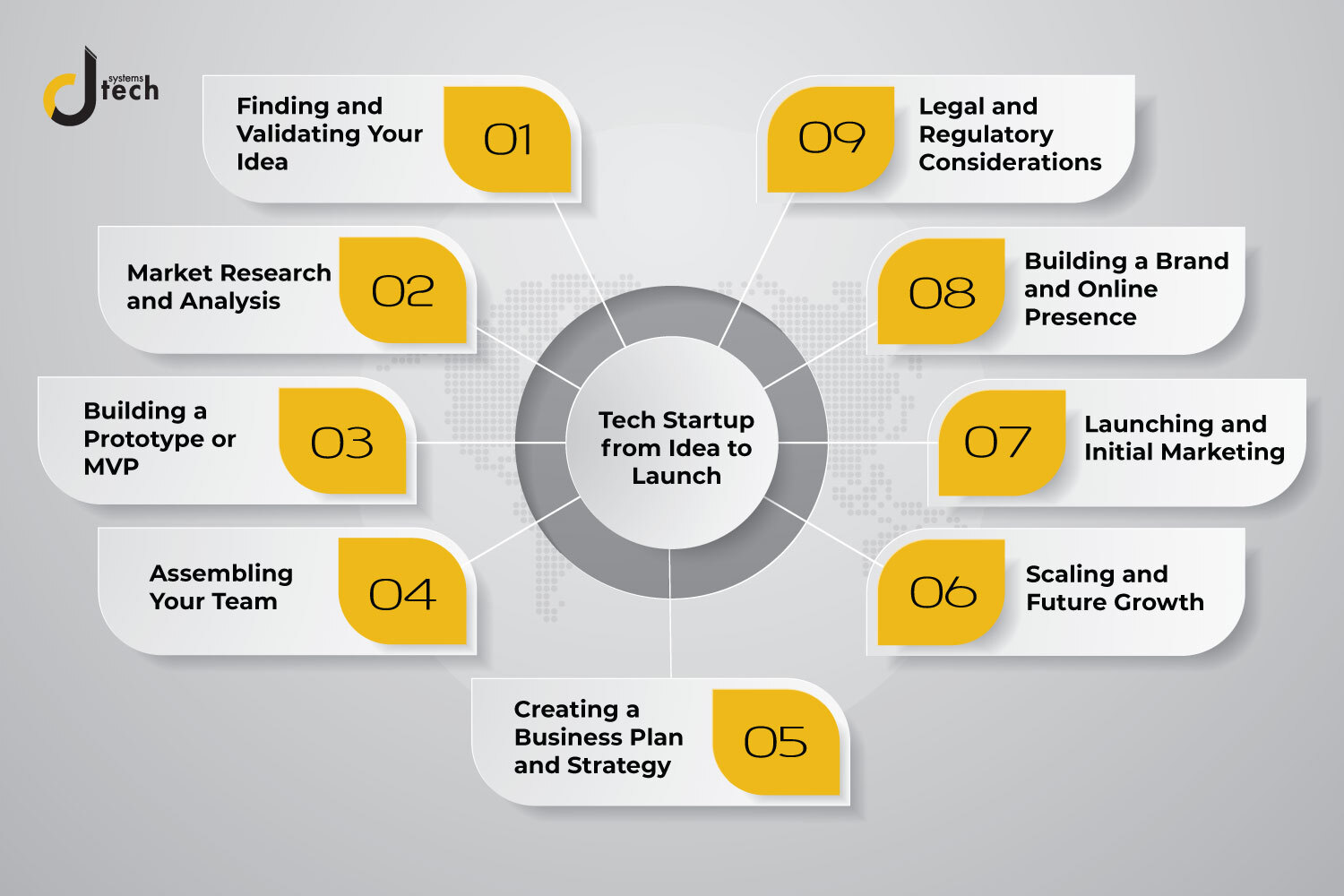
Finding and Validating Your Idea
A. Identifying a Problem
The core business is simply identifying, and attempting to solve, a problem. Study the pain points and unfulfilled needs of your target market intensely. This calls for more than skin-deep observation; understanding the intricacies that bother your audience.
This is where market research becomes important. Gather more information through surveys, focus groups, and competitor analysis. This is the basis for everything you do in developing your venture.
B. Brainstorming Solutions
Create a climate of uninhibited creativity and innovation on your team. Create a culture that encourages the flow of ideas, and is free of any prejudice. Breakthrough solutions come from diverse perspectives.
Use different ways or approaches, to idea generation, to encourage new ideas. Such activities include brainstorming or mind mapping. Note, that the more varied and extensive the ideas are the higher the likelihood of discovering an authentic innovative answer.
C. Validating the Idea
Your next vital step is the idea testing and MVP concept (MVP stands for Minimum Viable Product). The concept is about developing an efficient version of the product that meets the bare requirements. It also enables a direct entry into the actual market with invaluable feedback.
Connect with prospective users for suggestions and narratives. Their feedback is gold. You need to listen, be in the mood to observe, and also ready to give in to constructive criticism. You can use this key input to fine-tune your product in such a manner that satisfies the genuine requirements of your specific target market.
Market Research and Analysis
A. Identifying Target Audience
In this regard, defining your target audience helps in guiding your startup journey like you set a compass. Initially, it is important to develop specific user personas for each business department. These shall be fictitious figures representing your perfect clients. They should understand their demographics, behavior, pain points, and dreams. This is basically the foundation upon which you base both the design and the marketing for your product.
Similarly, user interviews are equally important. Interact with actual potential users in order to obtain more information on their requirements and tastes. Active listening and posing pertinent queries. These will prove highly beneficial pointers as your company grows.
B. Analyzing the Competition
Such an understanding of your competitors cannot be complete. Carry out a sectoral assessment and list major players in your market. Examine their products, competitive positioning, and customers’ tastes. As such, this analysis will tell you whether or not it is working for your niche.
In addition, do a SWOT analysis – analyzing strengths, weaknesses, opportunities, and threats of your startup. Through this practice, one discovers his special strengths and can pinpoint any weakness thus perfecting their plans.
C. Assessing Market Trends
Keeping abreast of industry trends involves sailing along with the wind. Keep tabs on technology changes, new customer behaviors, and emerging technologies consistently. It keeps you prepared and ready for the new opportunity.
In addition, try forecasting some of the future market needs according to your studies. Think beyond today and anticipate what your potential clients will require tomorrow. This is because you foresee and this helps you adapt and innovate as you stay ahead of those who are moving around.
Building a Prototype or MVP
A. Design and Development
The right tech stack sets up the pillars of your tech startup infrastructure. Measure your needs and select technologies that are suited for scalability, speed, and development scope. However, drawing wireframes and sketches helps envision the layout, making it easier and in harmony with your development team.
B. Development Process
Adopt Agile methodology for flexibility in adaptation. Such an iterative framework enhances cooperation, openness, and quick responses to dynamic needs. Ensure that you break down your project into manageable sprints that can facilitate continuous development and improvement.
Therefore, develops by iteration too. Revise your product continuously in small steps. This enables your tech solution to align with changing user requirements and industry dynamics.
C. Testing and Iteration
QA testing plays a crucial role here because it cannot be taken lightly. Strict testing produces a tough and fault-free product. Perform rigorous tests for dissimilarities and loopholes that may exist. It is a crucial aspect that ensures customers receive a dependable and usable service.
Additionally, be cautious when disregarding user comments. Include user insights drawn from testing phases as well as user trials. The iterative feedback loop makes sure that your product strictly fits the needs of the specific users.
Assembling Your Team
A. Co-Founders and Early Team Members
Building a startup is a team effort, and selecting the right individuals is critical. Identify the specific skill sets needed for different roles. Complement strengths and weaknesses within the team for a well-rounded foundation. Additionally, finding compatible partners who share your vision and values is essential for long-term success.
B. Hiring Employees
As your startup gains traction, you’ll need to scale your team accordingly. Understand the nuances of scaling the team – hiring for roles that fill gaps and propel growth. Develop effective interviewing and onboarding processes to ensure new team members integrate seamlessly into your startup’s culture and operations.
Creating a Business Plan and Strategy
A. Defining Your Value Proposition
A clear and strong value proposition for your startup forms its hinge of success. Highlight your differentiating factors – strengths that separate you from competitors. Provide an elevator pitch that captures your company’s value for possible customers, investors, or buyers in such as way that it keeps its audience hooked.
B. Financial Planning
Prepare a detailed budget that shows expenditure estimates, expected sales figures, and operating costs. Proper forecasting gives you the right predictions and enables good decision-making and proper allocation of resources.
Consider different financing methods if necessary. Securing initial capital is important regardless of it being bootstrapped, angel investments, venture capital, or grants. Make a strong and convincing business case to potential investors illustrating a clearly defined route for profitability.
C. Marketing and Growth Strategies
Identify and strategically approach your early adopters. Therefore, using your value proposition will help you attract some of these early customers to give your business the much-needed momentum.
As such, create a scalable model for attracting new customers as you grow and expand your business. This may involve focusing on your marketing channels, reducing user acquisition costs, and using a data-driven approach to growth.
Legal and Regulatory Considerations
A. Choosing a Legal Structure
Choosing the appropriate legal form in terms of your startup is an important issue. Explain the consequences that can arise with regard to taxation, liability, and management for each legal structure. Your decision should be tailored towards addressing the specific needs of your startup, as well as its overall strategic direction.
Consult with knowledgeable lawyers. Experts will also be there to help you understand the legal structures that exist in a certain area and comply with these laws.
B. Intellectual Property and Trademarks
Your brand and innovations should also be protected by protecting your intellectual property. Where possible, register trademarks and patents. It protects your brand image as well as the patented technologies and procedures from unauthorized usage.
C. Compliance and Regulations
Observing the set standards within the industry is part of creating a moral and lawful business. Familiarize yourself with the unique rules applicable in your field. It is important for a startup to operate within the defined law; failure to which it may incur a fine or penalty.
The need to adhere to applicable laws and standards regarding data privacy has also grown more urgent. Strong data protection mechanism to protect customer data.
Building a Brand and Online Presence
A. Brand Identity
This prompts recognition and trust which result in an effective brand image. Come up with an interesting look that will address your consumers. The consistency of your logos, colors, and design elements strengthens your brand’s recognition.
Determine the voice, language, and message of your brand. With this, you will have one consistent tone used in your communications that makes one identifiable brand.
B. Website and Social Media Presence
Your brand needs a strong online platform for easy accessibility and to connect with your target audience. Your website is a virtual store. Make sure it is simple, interactive, and user-oriented. Make it easy to navigate and access info from any page.
Make sure you have a good image on all relevant media platforms. Offer useful content, talk to people, and use focused promotional strategies to gain more traffic.
C. Content Strategy
The foundation for being visible online lies in high-quality content that promotes involvement. Make sure you diversify your content in order to accommodate various customer tastes. Constantly develop relevant, insightful, and interesting content that fits your brand.
Use some of the SEO best practices to increase ranking in SERPs for your website. Keyword research, on-page optimization, and the creation of quality backlinks are some of the activities involved in this process.
Launching and Initial Marketing
A. Soft Launch and Beta Testing
Start an intentional release (within a selected sample) for your product. This gives an opportunity for thorough testing and feedback in a regulated environment.
Use what you learn during the soft launch to improve your product. Deal with any problems or improvements prior to the general rollout of the project.
B. Marketing Campaigns
Create excitement that surrounds your upcoming launch. Sneak peeks, teasers, and behind-the-scene content can create anticipation and curiosity.
Distribute your advertising to different networks. Use social media, email marketing, and collaboration with influencers among others to get more coverage.
C. Measuring Success
Also, come up with a way of defining and tracking specific metrics related to the start-up’s aims. For instance, this may entail having measures such as user acquisition, conversion rates, and the level of engagement, among others.
After the launch, monitor user behavior and interaction with your product. Gain insight by collecting feedback on user behaviors. Make use of this data in order to be able to support your decisions on further iterations in a data-driven fashion.
Scaling and Future Growth
A. Scaling Strategies
Offer different products as customers’ demands keep changing over time. Offer complementary products or services that support or go alongside your startup’s mission.
Consider other previously overlooked markets/demographics that might need your product. Customize your approach to align with the distinctive expectations of the emerging segments.
B. Managing Growth
Rapid growth often comes with operational complexities. Streamline processes, invest in robust systems, and consider outsourcing certain functions to maintain efficiency.
As your team expands, preserving the culture that defines your startup becomes crucial. Communicate and reinforce core values to ensure a cohesive and motivated workforce.
C. Adaptation and Innovation
The business landscape is dynamic. Stay attuned to industry shifts and be agile in your response. Swiftly adapt strategies and operations to remain competitive.
Never stop innovating. Encourage a culture of experimentation and creativity within your team. This ensures your startup is always at the forefront of meeting evolving customer needs.
Conclusion
So there, let us conclude this brief guide by reminding you that many things started small, including even the giant multinational tech companies. Overcome challenges with open arms, read widely, and evolve quickly. The story behind your venture – from idea to success. Now it’s time to make history together with your revolutionary technology.
FAQs Related to Initiating a Tech Startup
How do I know if my startup idea is viable?
Identifying viability includes extensive research and testing of various markets. Run surveys, and interviews, and develop an MVP to collect information. Find a true market need that is addressed only by your concept alone.
How can I secure funding for my startup?
You can always go for different options such as bootstrapping, angel investment, venture capital, and crowdfunding. Create a good strategy, prove growth, and convince potential investors about your product or service.
What are some common pitfalls to avoid in the startup journey?
You should also prevent premature scaling, ignore what customers say, as well as undermine the power of good teamwork. Resiliency, flexibility, and a positive attitude in relation to mistakes are paramount traits when it comes to overcoming challenges.
Many founders grapple with a crucial question: The centrality of technology on the path of a startup is what brings about this conundrum, “do I need a CTO?” This blog from a product development company strives to simplify the relevance of the CTO, clarifying their invaluable duties and functions.
Whether starting a new investment or extending your business, the presence or absence of a CTO will be crucial for realizing tech-supported breakthroughs versus difficulties. Together, let’s find out the CTO role in startup directing your business to technical heights.
What is a Chief Technology Officer (CTO)?
A CTO for a startup, in this case, refers to a senior executive who is mandated with guiding their organization on the pathway their technology should take. They are one of the important factors in linking technology-driven initiatives with the business objectives of the company. In this regard, a visionary CTO is one who not only leads through the complex technological environment but also ensures that technology solution remains aligned with the strategic vision of the organization.
Typical benefits of a CTO role in a startup entail planning and implementing long-term technological plans, guiding technical staff, and spurring innovations. They choose suitable technology stacks, undertake security procedures, and monitor the creation of goods or services.
Startup CTO responsibilities and roles
A significant array of functions, define the CTO’s role and responsibility and determine what will make a startup start-up technologically savvy and capable of competing in the market. Therefore, let us focus on several main functions that describe the crucial significance of CTO in a startup.
Technology Strategy and Planning
The primary role of a CTO in a startup is to formulate and implement of technology strategy of a start-up. They appraise the current tech sphere, visualize upcoming developments, and make sure technological projects match the overall business goals of a company. It has to do with designing future technological maps and establishing new infrastructures, as well as innovations. The role of the CTO is quite clear – it offers a purposeful, future-oriented technology direction for the startup’s ventures within a specific sphere of business.
Team Building and Leadership
A CTO is responsible for organizing a team of competent individuals under him to function in unison toward the general goal. These encourage openness for idea sharing, innovation, collaboration, and lifelong learning. The CTO encourages the team to work through complicated technical issues and build quality products or services through effective mentorship. Moreover, they define goals and make sure that the operations of a team comply with the entrepreneurship concept.
Product Development and Innovation
A fundamental aspect of a CTO’s work is driving product development and innovation. They are responsible for every stage of the product life cycle including product conception to deployment. Working hand in hand with product managers, designers, and engineers to ensure the start-up products address existing market demands is critical. In addition, the CTO identifies new generation systems that help improve other products of the startup.
Technology Stack Selection and Management
Technology choice and technology management constitute the success formula of any startup. Through this process, the CTO assesses multiple frameworks, programming languages, and platforms, identifying which is the best fit for the company’s requirements. These help them make sure that their selected stack is scalable, affordable and fits in with the startup’s strategic agenda. The CTO also involves improving the available systems and tools to make them more effective in delivering services.
Security and Compliance
The CTO is required to protect the startup’s digital assets as well as comply with industry regulations. They design strong security systems that are effective in countering cyber crimes as well as breaching data and unauthorized access. The CTO is also aware of developing compliance standards and makes sure that the technology infrastructure of the startup meets up with legal aspects and industry-specific requirements. Such concerns are associated with personal information protection, privacy, and specific industry certificates.
When Should a Startup Hire a CTO?
The choice of whether or not to hire a CTO at this point in a startup process is one such crucial milestone. Here are key indicators signaling it’s time to consider hiring a CTO:
1. Need for a Technical Visionary
Hence as your company develops, you will need to focus on finding a visionary CEO whose technology will link to the general business approach. Foresight from a CTO is essential for navigating such tech obstacles as well as opportunities.
2. Scaling and Growth Plans
As such, when your startup is ready for fast expansion, a CTO becomes indispensable in forming solidly built as well as highly scaled tech infrastructure. These help you create a reliable, scalable foundation for your technology setup so that you can handle more users and new features.
3. Security and Compliance Concerns
Depending on whether you are handling sensitive information or operating under a regulated industry, a CTO would be key to developing and upholding effective security procedures as well as adhering to professional rules and regulations.
4. Lack of Technical Leadership
The presence of this situation indicates that there should be a CTO who will provide leadership, guidance, and direction to the current technical team.
How to Find the Right Chief Technical Officer for Your Startup?
It is also crucial to find the right CTO for your company as this will be one of the defining factors of your long-term success. Here are key strategies to guide your search:
1. Define Your Needs and Vision
Explain the needs of your start-up regarding technology and define what you’d like to accomplish in the future. This will be your guiding principle when looking for someone who understands what you stand for and has the required skills.
2. Leverage Your Network
Engage in your professional networks, relevant trade shows, and startup communities. Find out potential CTOs by seeking referrals and recommendations from trustful individuals.
3. Look for Relevant Experience
Experience in handling startups, and other related fields is a prerogative. The experience and success stories that come with a CTO who has been able to scale up technology in fast-moving markets make it very valuable.
4. Assess Problem-Solving Skills
Assess their ability to handle complex techno-based challenges. A startup business normally faces challenges that call for problem-solving skills; it also relies on innovation in the market and may lead to success.
5. Evaluate Leadership and Communication Skills
Therefore, a CTO has to develop his/her leadership skills well enough to guide his tech team. Identify those people that show effective leadership and clearly explain complicated information.
6. Cultural Fit is Key
Make sure that the CTO fits into your company’s culture, values, and work ethic. Work style compatibility leads to workplace harmony since it encourages a harmonious working environment.
7. Consider Equity and Compensation
Set for determining fair and competitive pay packages such as equity or bonus. This shows your dedication towards CTO’s contribution to a successful company.
8. Conduct Thorough Interviews and Assessments
Use tough hiring approaches like technical interviews, and hypothetical questions to evaluate candidates for employment. This enables one to measure a job applicant’s capability in handling complex issues and resolving problems.
Conclusion
Dynamically, the CTO is the glue in technology that holds together startup movement. The foundation for the success of startups is based on their strategic foresight, team leadership, and technical competence.
In addition, a suitable match for a CTO may act as a stimulus for innovations and development as you go through the entrepreneurship trail. Thus even if you are in the initial phase or scaling up quickly, you need an inseparable component in the startup’s table – that of a CTO.
FAQs Related to Hiring a CTO
What is the requirement of a CTO?
A CTO ought to have technical competence, good vision, foresight as well and leadership qualities. The managers have to direct the competent personnel to develop and maintain a reliable enterprise IT framework that is in line with the strategic objectives of the organization for the purposes of organizational development. Moreover, it is vital for them to constantly track new technologies in order to be ahead of competitors.
Does the CTO need to be technical?
Yes, a CTO normally requires a good technical background. It entails a high level of professional knowledge about applicable technologies and the ability to make technical decisions. Also, although technical skills are important, the CTO must be able to communicate well and have leadership skills so that he can work together with the team, and connect IT with organizational goals.
Should a startup have a CTO?
It depends on whether its nature and scale are small or wide. In addition, most start-up companies heavily dependent on technology of developing complex products often have their CTOs. Although in some cases a technical co-founder might suffice or an accomplished project lead at first. In addition, as the startup progresses, it becomes necessary to think of a dedicated CTO for strategic technical planning and scaling in the long run.
What is the difference between a CTO and a COO?
Most importantly, a CTO is in charge of the technological direction of a company. Their area is more inclined in the direction of technology strategy, product development, and new ideas.
Nevertheless, a COO (Chief Operating Officer) supervises daily activities and makes sure smooth business flows are created. They are responsible for managing departments/functions such as human resources, finance, or even technology.
In addition to using technological tools, a CTO is strategic in using them while the COO pays attention to the day-to-day operations and the performance of the company.
Can a CTO become a CEO?
Yes, a CTO may be qualified for the position of CEO by having some leadership, strategy, and business competence besides the skills of a techie. The change may happen in case the company places value on its vision and leadership ability. On the other hand, the CTO should develop more varied skills wider than only technical ones to run correctly each part of the company.
Starting a start-up can be a thrilling journey but it will have various technology problems. Selecting a good technology package and protecting one’s self against hackers becomes all about getting lost in the cyber jungle.
It is here that the chief technology officer (CTO) takes up the role of your lighthouse. They cut through all the complexities to give you a strong tech foundation. Come with us as we show you how a CTO can be the key that will help you conquer those challenges and make your startup victorious.
Benefits of CTO for a Startup
Here are the benefits that a chief technical officer can provide your startup:
Strategic Technological Vision
A well-defined technical vision is what propels a startup’s success. In this part, we discuss how a CTO steers the organization’s objectives, matching technological developments with the firm’s objectives and future trends to ensure that such growth and innovation are sustainable.
Setting Technological Direction
Your first compass should be a CTO, which will point your tech startup in the right way. They choose and define the technology stack in line with your organization’s goals. This is where a strategic alignment takes place and all of the tech decisions ensure that they add value toward a larger vision.
Long-term Planning
A CTO goes beyond short-term needs and develops a technology roadmap for future endeavors. They predict upcoming trends, keeping you one step ahead. Taking this proactive stance protects you from becoming outdated, and enables your business to grow indefinitely.
Apart from being proficient, a chief technology officer startup builds an environment that promotes exceptional performance. These individuals direct development teams and help promote high levels of professionalism associated with writing and testing good codes in your start-up.
Technical Proficiency
One benefit that comes with a CTO is technical expertise. These are also referred to as senior developers who superintend development teams while setting high values on code quality, including various best practices. This enables them to write a line of code that is a solid building block for a reliable, flexible, and lean system.
Team Building and Management
The CTO’s roles and responsibilities startup go beyond mere technical mastery to provide leadership to his or her team. It entails the recruitment of leading IT personnel who promote creativity and business advancement. A good and well-organized team of people you have will take your company forward even at times of difficulties and favorable moments.
Risk Mitigation and Scalability
A startup should maintain security and scalability if it is to stand the test of time. In this discussion, we examine the importance of a CTO in safeguarding your startup against cyberattacks, and creating scalable systems that adjust as your demands increase.
Security and Compliance
Any start-up should take this cybersecurity issue seriously. The CTO is the one who ensures that strong security measures are put in place to ensure that confidential information or even possible breach is avoided. Moreover, they also guarantee that there is adherence to industry standards and regulatory measures providing a sense of security to key parties in the company.
Scalability and Performance Optimization
The start-up needs a chief technology officer who will design a system that is scalable such that it accommodates the growth of performance. They do periodic reviews and fine-tuning to ensure that your technology infrastructure is agile enough to respond competently to changing demands.
Product Innovation and Development
A healthy start-up must always innovate in order to survive. Find out how a CTO leads ideation and manages product-development processes to keep your products ahead in your market.
Ideation and Innovation
Any succeeding startup must have innovation as its “blood”. In this instance, a CTO is the driver of innovation, coming up with new ideas and thoughts. They determine feasibility, directing your team to revolutionary breakthroughs that give your startup an edge over other firms.
Product Development Efficiency
Improves rapid iteration and product success by being efficient! CTO improves upon development processes and removes bottlenecks to optimize efficiency. By using this agile approach, you ensure that your startup can be flexible enough to face such problems as changing conditions of the environment, users’ demands, or competitive pressure.
Effective Communication and Stakeholder Management
When it comes to tech and business, a CTO is the person who can balance them. You can think of them as a bridge. Their goal is to make sure that technical decisions align with strategic objectives and this allows them to foster collaboration and informed choices.
Bridge Between Tech and Business
Technical concepts might as well be a whole different language. This is where a CTO steps in, they act as the translator. They bridge the gap between these two worlds by marrying technology and business objectives. Doing this lets businesses make better decisions for their overall strategy, which in turn helps move their startup forward.
Vendor and Partner Management
Working with third-party providers is essential for early startups. And this isn’t just limited to figuring out how they can work together. The CTO also figures out if they can work together at all. If what a provider does doesn’t align with your startup’s needs or standards then there’s no point in forcing them together. This harms resource utilization and relationships with other companies. But when it works out, all parties benefit from it — which includes you.
Cost Optimization and Resource Allocation
Maximizing accessible resources is really important for a startup to last. In this section, we will be going through how a CTO goes about managing budgets and negotiating costs. They also do one other thing that has long-term success.
Budgeting and Resource Allocation
Being able to effectively maintain their resources is very important for a startup. A CTO watches the money and ensures that every penny spent delivers value. Through the strategic allocation of where they need to go, they optimize your startup investments so that it last.
Technology Procurement and Vendor Negotiation
Getting the right tech at the right price without sacrificing quality is another key point in running a startup. A CTO identifies cost-effective solutions without compromising quality. They negotiate contracts and licenses with technology vendors, securing the best deals for your startup’s needs.
Hiring a CTO is like turning on a light while walking through a dark room. They’re there to fortify your tech strategy, predict challenges that lay ahead, and help you steer toward success. With one of these people at your side, you’re not just going through obstacles – you’re surmounting them. Embrace this invaluable asset and watch your startup thrive.
FAQ Related to Benefits of CTO for a Startup
What qualifications and experience should a CTO ideally possess?
The main thing is they need to have a solid background in technology. Something like a computer science degree. But they should also be as skilled in software development and project management as possible. And of course, know how the ecosystem works.
Extra credit goes to those who’ve had leadership roles in tech companies or successful startups before. Alongside having excellent communication skills and can make tech decisions that align with business goals.
Can a startup function without a dedicated CTO?
The short answer is yes, but it’s not recommended. Especially if the company’s growing. Without one, technical decisions are just gonna be improvised which isn’t good at all.
A CTO is there to help guide the company forward and align its tech with business goals. They also bring invaluable expertise that can increase the chance of success a lot more than if they weren’t there.
How does a CTO contribute to cybersecurity and data protection?
A CTO plays a crucial role in regard to cybersecurity and data protection. They make sure that the security measures are strong, like encrypting protocols and secure authentication methods. Even access controls.
They also have to keep up to date with the best practices and requirements that the industry has set out. This way the company’s technology infrastructure can be protected against anything.