Did you ever dream of becoming a tech entrepreneur only to realize that you have no technical skills and can’t start? You’re not alone. Many aspiring entrepreneurs are constrained by the misconception that a tech background is a necessity while starting a tech company.
But here’s the secret: it is not about how much code you can write but your vision, resoluteness, and your assembling of the correct team. This guide by a startup product development company will help you to open a successful enterprise in the field of technology, even though you haven’t got enough knowledge in the tech area. Make that dream come true now.
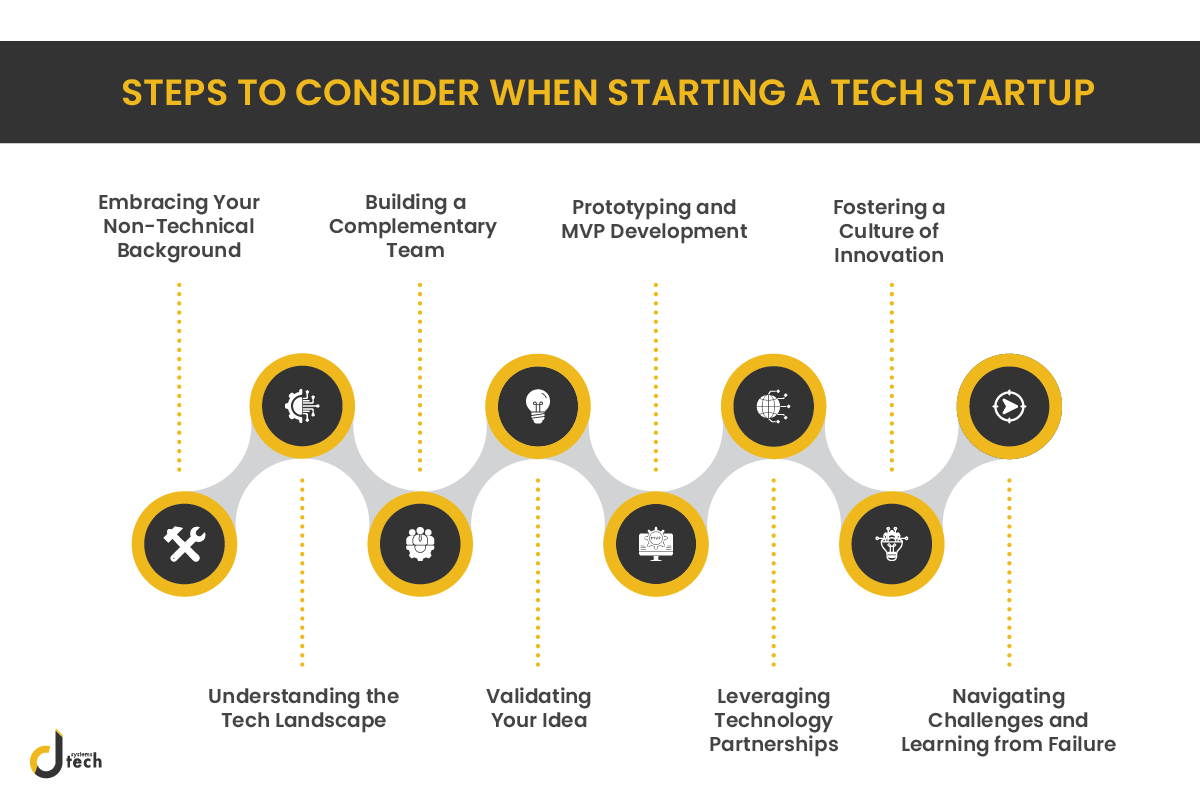
8 Steps to Consider When Starting a Tech Startup
By having a positive attitude, an ideal crew, and smart tactics, you’ll be able to convert your business idea into a successful one. The following are eight critical steps that will serve as your guide in building a tech startup. Each of these stages should be carefully considered for success in the market.
1. Embracing Your Non-Technical Background
Some people may think starting a tech company without being a techie is daunting but this could also be an advantage. Your new point of view may produce creative answers. Be proud of your specialization – maybe it’s marketing, finances or designing – and take advantage of using them together with the technology-oriented part of your business. Do keep in mind that diversified teams frequently result in more refined and prosperous firms.
2. Understanding the Tech Landscape
In most cases, you wouldn’t necessarily have to be a great coder but you have to at least know what technology is all about. Learn about recent shifts, innovations, and how software and hardware operate in general. With such information, you will be able to talk well with the technical team as well as have decisions made for you, and also keep time in this fast industrial area.
3. Building a Complementary Team
The next most important thing is to surround yourself with the right kind of people. Recruit skilled people as CTOs and developers. Include experts in the fields of marketing, design, finance, and operations on your team for balance. It is the battery of these skills that is your powerhouse and ensures that every aspect of the start-up caters for in the process.
Validate your idea before embarking on developing it. Carry out detailed market studies, get feedback from prospective customers, and analyze the competitive environment. That step can determine whether there is a true need for a product or service. If that’s the case, it will save all the investment of time and cost.
5. Prototyping and MVP Development
Creating a prototype or MVP is no longer rocket science. Build a prototype using no/low code platforms. You should therefore create a prototype that could be an actual test bed in which you make the improvements based on actual users’ feedback.
6. Leveraging Technology Partnerships
Don’t hesitate to partner with tech specialists and development organizations. However, collaborations would ensure great technical assistance, mentoring, and access to resources. Find a business partner whose direction corresponds with your vision and who will push your venture ahead.
7. Fostering a Culture of Innovation
Promote innovation as well as challenge your team members in your team. Cultivate an atmosphere of open communication and controlled risk-taking. A culture of innovation will sustain continuous improvement in order for you to have a resilient and competitive startup.
8. Navigating Challenges and Learning from Failure
Not all challenges are bad – they constitute part of our growth.+ Embrace setbacks as learning experiences. Learn what went wrong and move forward with new vigor. Several technocrats failed while succeeding in tech business today. Keep moving forward.
Conclusion
As we conclude this blog, always keep in mind that your non-technical orientation is more of a chance rather than a handicap. Tech entrepreneurialism is dependent upon a diversity of thoughts and skills. If you can maintain a positive attitude, a good team, and validate your idea, then you’re almost there. Therefore, just jump and convert your tech startup dreams into real life.
Still not sure what to do? Contact us we are here to assist you in your success
FAQs Related to Starting a Tech Company
Can I start a tech company with no experience?
Yes, it is possible to set up a tech startup without any background. View yourself as an outsider with a fresh new look in a non-technical field. Concentrate on building a mixed and competent team, intensive market research, and utilizing technology alliances. You need to be a lifelong learner, with a constant growth mindset.
What is the best structure for a tech startup?
The best structure for a tech startup often involves a mix of technical and non-technical roles. A common setup includes a CEO handling overall strategy, a CTO overseeing technical aspects, and key roles like developers, designers, and marketers. Additionally, having advisors or mentors can offer valuable guidance. Adapt the structure based on your specific product and team strengths.
How long does it take to start a tech startup?
The timeline to start a tech startup can vary widely. It typically takes several months to a year to go from ideation to launch, but this can be shorter or longer depending on factors like complexity, market research, and team availability. Keep in mind that success may require ongoing development and refinement, so be prepared for a longer-term commitment.
What skills do I need to start a tech startup?
For building a technology company or a tech startup, key skills include:
Entrepreneurial Mindset: Vision, risk-taking, and adaptability.
Leadership and Management: Team-building and decision-making.
Market Research: Understanding customer needs and competition.
Communication: Effectively conveying ideas to both technical and non-technical team members.
Basic Tech Understanding: Familiarity with industry trends and terminology.
Problem-Solving: Creative solutions for challenges.
Networking: Building partnerships and seeking mentorship.
How long do most tech startups last?
The lifespan of a technology startup may be very short. Many start-ups fail on average for five years. Nonetheless, these startups with success may expand further and achieve for years. Such factors determining longevity are market conditions, good management, product-market suitability, and flexibility to change with time. Given appropriate methods and implementation; a tech start-up may have a good run.
What did Jack Ma, Steve Jobs, Reid Hoffman, and Brian Chesky have in common? They all are successful founders of their companies, despite not having enough education or experience in relevant fields. For example, Brian Chesky, one of the co-founders of Airbnb did his majors in Industrial Design, before finding a gap in the market and establishing a massively successful startup. In short, all of these co-founders were good at finding the right technical skillset to be successful.
Finding tech people with requisite skills and competence is a significant challenge for non-technical founders. Not only is it hard to find them, but providing instructions to technical experts is also a difficult task.
While the unique strengths of non-tech founders contribute significantly, relying on tech experts is imperative for a product development company. Without a trusted partner, navigating the technical landscape can be daunting for a non-technical cofounder. Some of the most successful companies did not have technical founders, but they were really good at one thing: finding the most reliable technical experts to convert their ideas into reality.
Non-tech startup founders must seek individuals who not only possess requisite skills but also resonate with their vision. Articulating this vision clearly is paramount, igniting passion in potential team members. Prioritizing versatile hires is key, ensuring they meet present and future needs.
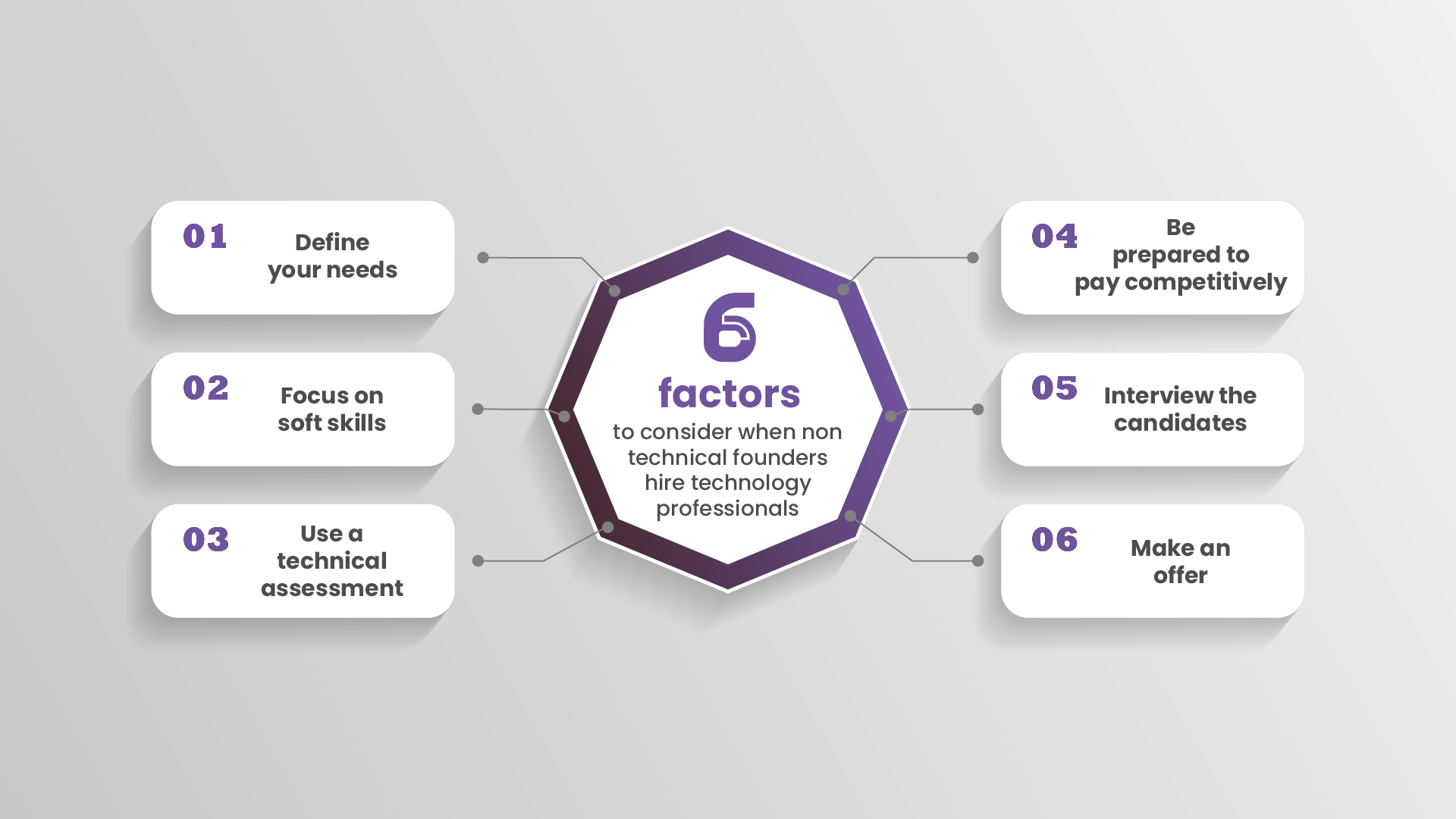
6 Factors to Consider While Hiring Tech Professionals for Non Tech Founders
Define your needs
Defining the project needs should be the first thing such asidea testing and MVP development. One thing non-technical startup founders should consider is discovering whether any skills and qualifications are needed by their tech team. Remember that those people will be responsible for various tasks.
After doing this, we will come up with a good job description.
Here are some questions to help you define your needs:
What is the essence of your product’s technology stack?
What are the main technical issues that your team will have to overcome?
What is your budget?
Focus on soft skills
Without a technical education, you can judge candidates on various “soft” criteria — for example, the ability to communicate or work in a team, or the ability to solve problems. As such, these skills are equally important technical skills and, in fact, even more so for early-stage startups.
Here are some specific soft skills to look for in candidates:
Communication: Can the candidate clearly and concisely communicate their ideas?
Problem-solving: Can the candidate think critically and solve problems creatively?
Teamwork: Can the candidate work effectively with others?
Work ethic: Is the candidate motivated and hard-working?
Cultural fit: Does the candidate fit your company culture?
Use a technical assessment
In case you are unsure of the way to gauge technically savvy candidates, you can utilize a technical assessment instrument. Such include coding challenges and other tests that may help recruiters discover the best people having appropriate qualifications.
Here are some popular technical assessment tools:
HackerRank: One of the best-known technological assessment tools, HackerRank, features numerous coding challenges.
CodeSignal: Another widely used technical assessment instrument with different types of coding exercises is the CodeSignal.
LeetCode: As a result, there are a number of websites but one notable one of them is LeetCode.
Be prepared to pay competitively
In the tech world today, the best talent will come at a competitive price and therefore, employers should also be ready to pay competitively. Search online for what other startups in your locale are paying for such positions.
Interview the prospects
The process of identifying potentially suitable candidates is followed by the actual interviews. Make sure you pose some technical and some non-technical questions.
Here are some technical questions you can ask:
How do you find our tech environment?
How does it work for you in terms of tech setup?
What were some of the technical issues that you’ve had to contend with and how did you resolve them?
Here are some non-technical questions you can ask:
What is your motivation for being considered to fill this position?
What are your career goals?
What are your strong points/weaknesses?
How do you handle stressful situations or pressured circumstances?
How do you handle conflict?
Make an offer
Having interviewed all the contenders for the post, it is now appropriate to extend an offer to the one best fit for it. An extensive package of details like salary, benefits, and starting date should be provided.
Technology founders not in the technical field are prone to difficulties when it comes to hiring technology personnel or firms. Nevertheless, creating a high-tech unit for greatness deemandly possible.
Conclusion
Hiring technology professionals or firms may not be an easy thing, but it is essential for any startup to succeed. Following the provisions outlined above will increase the possibility of putting together an appropriate labor force for the company. You need to invest in a good technology team for your startup. When done right, it prepares you for success.
FAQs
How do I negotiate salaries and benefits with candidates?
While discussing salaries and benefits with prospective employees, one should be well-prepared. Conduct research into what other start-ups are paying in your locality for comparable positions. At this point, you must also calculate the cost of benefits that you should add to these offers.
How do I onboard new hires?
The onboarding of new hires is a crucial procedure that enables them to become productive within a short period and be part of the team. You could also develop a welcome packet that consists of details concerning the firm, the unit, and the position. Plan a meeting with the newly recruited person to go through their job description and expectations. Regularly check in with the new hire for updates and address their concerns.
How do I manage a remote tech team?
Although it is tricky to succeed in managing a remote tech team, it is achievable. Ensure that your team members know your expectations as well as the goals they should attain.
Provide regular feedback. You also have to keep giving your teammates feedback about their work more often than not. This will enable them to correct and keep them in line. Encourage communication and collaboration. Ensure your teams share information and cooperate. By so doing, it will develop a robust team culture.
How do I build a high-performing tech team?
It is not a simple process to build a high-performing tech team. Hire people with the relevant skills, experience, and passion for work. Develop a learning-based culture. Motivate your team to learn more and evolve. In turn, this will enable them to go with what is new in technologies and trends.
Facilitate opportunities for growth and advancement. Provide your employees with chances to develop within their professions. This will in turn motivate them and keep them engaged.
The 21st century is witnessing the transformative impact of the digital revolution, where Artificial intelligence (AI) and Machine Learning (ML) integration are reshaping the future of software project recovery services. This exploration delves into how AI and ML govern the rescue of software development projects, revamping conventional landscapes for optimal outcomes.
AI & ML Transformations
1. Predictive Analytics: The Proactive Pathway
Predictive Analysis
In the realm of software project rescue, AI and ML offer a significant advantage by proactively predicting potential challenges. Through the power of Predictive Analytics, fueled by ML, these technologies delve into past data to identify patterns that can help foresee project delays. Managing the intricate orchestration of software development often poses a daunting task when it comes to project scheduling. However, ML can greatly alleviate this challenge by providing accurate projections for tasks and deadlines, thereby enabling more informed management decisions.
Meanwhile, AI applies its impressive pattern recognition capabilities to detect signs that signal a potential distraction from the project’s course. By identifying these signs early, project managers can employ the necessary evasive actions to veer the project back onto its track.
2. Data-Driven Decision Making (D3M)
The future of software project rescue is set to revolve around data at its core. AI-equipped tools are predicted to replace human intuition and emotions with D3M, a transformative technology. While these assumptions draw upon years of industry experience, they still retain subjective elements and vulnerability to bias.
Instead, project decisions can rely on solid metrics and unequivocal data patterns. This approach reveals more accurate directives for allocating resources, managing risks, and prioritizing tasks. As a result, project managers gain the distinct advantage of basing their strategies on facts rather than mere conjecture—a valuable asset when rescuing a software project in need of triage.
3. Risk Management with ML
Project management is akin to navigating a ship in turbulent waters, where risks pose constant threats. ML equips project managers with the power to foresee these risks and devise a preemptive strategy before they manifest as project deterrents. Through correlation analysis of past data, ML can predict potential risks and offer a more proactive risk management strategy.
According to research conducted by the Project Management Institute (PMI), project managers devote a significant portion, approximately 54%, of their time to handling administrative tasks. Artificial intelligence (AI) plays a crucial role in alleviating this burden by managing various responsibilities including meeting organization, document interpretation, and report generation.
AI can automate various everyday tasks, which can significantly reduce the time needed for their completion. With AI algorithms taking care of tasks such as scheduling meetings, interpreting complex reports, and generating diverse documents, a substantial amount of time is saved. This allows project managers and software development companies to allocate their valuable time towards strategic operations, ultimately enhancing the success rate of software project rescue interventions.
AI & ML: The Vision for the Future
1. Real-Time Project Management
AI and ML are revolutionizing project management. They enable real-time adjustments to project parameters in response to fluctuating external and internal factors. As a result, changes such as team availability, resource allocation, and project deadlines can be seamlessly updated in real-time. This transformative approach has the potential to minimize project timeline overruns and budgeting issues, completely transforming the way software projects are rescued.
2. The Rise of AI-Powered Bots
AI-powered bots
AI-powered bots, also known as AI ChatBots, are emerging from the realms of AI advancement. These virtual team members excel at providing real-time updates to project stakeholders. They handle routine queries about project status, assignment updates, and resource availability that were traditionally managed by project managers. The presence of these bots brings greater transparency to project management and eliminates friction points that could potentially escalate a project, thereby mitigating the need for software project rescues.
Deep Learning, an advanced facet of AI, simulates the functioning of the human brain to process data and uncover patterns for decision-making. It can forecast future trends that can impact project trajectories, such as determining when additional resources may be needed or predicting performance-based risks. This remarkable capability significantly enhances the efficiency and accuracy of software project rescue operations.
4. Personalized Experiences and Services
Personalized experiences and services, made possible by advancements in AI and ML, play a crucial role in customizing products, interactions, and offerings to cater to the specific preferences and needs of individual users or customers. Segmenting and profiling individuals based on shared characteristics helps create targeted experiences. Additionally, AI-powered recommendation engines improve personalization by suggesting products or content that align with a user’s past behavior.
5. Continual Learning and Adaptability
Lifelong learning, transfer learning, and meta-learning are techniques that enable models to accumulate knowledge from new data without starting from scratch. This capacity is particularly crucial in scenarios where data distributions change over time. AI systems equipped with continual learning can adapt to these shifts without compromising their performance. Furthermore, continual learning empowers autonomous systems like robots and self-driving cars to learn and adapt to new environments, tasks, and challenges they may encounter.
Challenges and Bottlenecks
Developing technologies always encounter challenges, and AI and ML are no different. The triad of hurdles threatening the integration of AI and ML into project management consists of data privacy concerns, lack of accurate and ample training data, and fears regarding job loss. However, it is crucial to consider the bigger picture—their role in facilitating faster, more effective, and efficient software project rescues.
Concluding Thoughts
AI and ML go beyond being mere technological upgrades; they represent a paradigm shift in conventional methodologies for rescuing software projects. They pave the way towards a dynamically evolving ecosystem where decisions are driven by data, predictions are made at the right time, automation liberates valuable time, and communication remains transparent.
As technologies continue to grow and mature, they hold the key to unlocking even greater potential that will reshape the landscape of project management. This ongoing revolution is set to change how projects are approached and planned. Connect with us to make your project exceptional.
In today’s rapidly evolving digital landscape, businesses face the challenge of developing cutting-edge software applications to outpace their competitors. The question arises: Is it more efficient to embark on software development in-house or delegate this task? In this insightful discussion, we will delve into the dynamics of software product development and explore the growing trend of outsourcing in 2023. By decoding the paradigms of outsourcing, particularly in the realm of product development, we aim to unravel the benefits, challenges, and considerations that can help businesses make informed decisions. Whether you are seeking access to expert developers, cost savings, or faster time-to-market, understanding the advantages of outsourcing can be the game-changer your business needs in this digital era.
In the following discussion, we will explore the dynamics of digital product development through the lens of outsourcing, specifically focusing on its progression in 2023.
Decoding the Outsourcing Paradigm in Software Product Development
The realm of software product development is a complex journey that encompasses ideation, product design, testing, and maintenance. Entrusting this intricate process to an established software product development company represents the essence of outsourcing.
One significant advantage of outsourcing is access to expert developers. These professionals have honed their skills in the trenches of software development, providing businesses with a wealth of expertise. Additionally, outsourcing can result in cost savings, as it translates to reduced labor and infrastructure expenses. These resources can then be redirected toward strengthening other aspects of the business.
How Could Outsourcing Software Product Development Benefit My Business in 2023?
Outsourcing in 2023 brings various benefits to businesses. It provides access to expert developers, results in significant cost savings, and enables faster time-to-market. This allows companies to prioritize their core operations effectively. The crucial factor for success lies in selecting the right outsourcing partner that aligns with your business goals.
2. The Value Proposition: Benefits of Outsourcing Software Product Development
Outsourcing in the digital product development landscape offers several rewards:
2.1 Expertise in Your Disposal
With an outsourced team, you gain the prowess of professionals who have honed their skills in the trenches of software development.
2.2 Economical Efficiency
Outsourcing can translate to substantial savings on the labor and infrastructure front. These resources can be redirected to strengthen other business aspects.
2.3 Accelerated Go-to-market Timeframes
Outsourcing helps streamline the software development life cycle, bolstering productivity, and hastening your product’s launch.
2.4 Prioritizing Core Competencies
Allocating peripheral tasks to an external agency allows businesses to refocus their resources on their core competencies.
What are the Main Challenges of Outsourcing Software Product Development?
While outsourcing can offer multiple benefits, it may lead to possible challenges like loss of certain project control, potential communication issues due to language or time zone differences, and dependence on an external entity for critical development tasks. These challenges can, however, be mitigated by planning and selecting the right partner.
3. The Other Side of the Coin: Possible Pitfalls of Outsourcing
Revenue Growth Illustration
While there are potential drawbacks to outsourcing, these can be minimized by partnering with a company that aligns with your entrepreneurial ambition and organizational ethos. Carefully considering the advantages and challenges of outsourcing software product development will set the stage for businesses to foster innovation, and expansion, and establish a strong presence in the digital era of 2023, it’s crucial to shed light on potential bottlenecks:
3.1 Control Compromise
Surrendering software product development to an external entity often implies losing some managerial control over the project.
3.2 Communication Hiccups
Cultural and language barriers, accentuated by time zone variances, can lead to miscommunication, impeding project timelines.
3.3 Reliance Risk
An over-reliance on an external vendor might culminate in a dependency, which can pose substantial challenges in case of contract dissension or untimely termination.
4. Judicious Judgment: Is Outsourcing the Right Move for Your Business in 2023?
The in-or-out problem must consider the industry’s consequences, trends, and the pace at which digital product development technology is advancing. In 2023, outsourcing is emerging as a viable prospect, given the depth of expertise and cutting-edge industry knowledge an established software product development company tends to offer.
Although outsourcing harbors its trials, these can be substantially mitigated by partnering with a company that mirrors your entrepreneurial ambition and aligns with your organizational ethos.
Conclusion
In the realm of 2023, considering the prospect of outsourcing software product development warrants careful consideration. This decision brings forth a multitude of advantages – encompassing specialized expertise, cost-effectiveness, and a realignment of business strategy.
However, it is crucial to thoroughly contemplate any potential drawbacks that may arise. Ultimately, choosing the right depends on individual business requirements, available resources, and strategic objectives. Approaching this matter with balance sets the stage for businesses to foster innovation, expansion, and establish a strong presence in the digital era.
In the vast realm of technology, a transformative revolution silently unfolds. It holds the promise of reshaping our very world—how we live, work, and create. AI and IoT serve as catalysts for this groundbreaking shift, but they are not alone in their endeavor.
As we step into the threshold of 2023, a multitude of other forces converges to reinvent the landscape of software product development. Through this article, we aim to unravel the intricate web woven by these emerging trends and explore their profound impact—an opportunity for you to catch a glimpse into the captivating future of software product development.
1. Dominance of Artificial Intelligence (AI)
Artificial Intelligence is a game-changing technology that is at the vanguard of reshaping the software product development landscape.
AI-Driven Automation Illustration
1.1 AI-Driven Automation
AI-facilitated automation has significantly enhanced software productivity. By automating mundane repetitive tasks and providing complex problem-solving capabilities, AI has made software development more efficient, resulting in time and resource savings.
1.2 Augmented Coding
AI-powered tools assist coders by predicting code and resolving bugs, thereby speeding up programming tasks and enhancing software quality. As a result of these inherent benefits, businesses are increasingly gravitating towards AI-infused development platforms.
How is Artificial Intelligence Impacting Software Product Development in 2023?
In 2023, Artificial intelligence emerges as a prominent trend, exerting significant influence on software product development. By automating routine tasks and enhancing coding efforts, AI-powered tools greatly assist developers in predicting code outcomes and resolving bugs. This results in faster and more refined programming tasks, ultimately boosting software quality and productivity.
The reach of IoT transcends beyond our homes and offices and permeates into software development methodologies. Some of the influencing trends are:
2.1 IoT Security
The security of the expanding IoT landscape is crucial. To address this, developers are increasingly embracing emerging technologies like Blockchain to strengthen IoT structures and mitigate threats such as data breaches or hacks from occurring.
2.2 Edge Computing
The migration of data processing tasks from cloud data centers to the devices at the “edge” of the network, known as edge computing, addresses latency issues, boosts processing speed, and optimizes bandwidth usage. This transition has prompted a heightened emphasis on edge computing in software product development.
3. Microservices Architecture
Microservices Architecture Coding Illustration
The microservices architecture, constituted by small, independent services working together, minimizes complexity and enhances scalability.
3.1 Shift from Monoliths to Microservices
Monolithic architecture is being gradually replaced by the more efficient and scalable microservices architecture. This approach benefits developers by allowing them to deploy and update software components independently, thereby improving scalability and flexibility.
4. Beyond the Obvious: Emerging Trends
Besides AI and IoT, software product development is witnessing other ground-breaking advancements.
4.1 Low-Code/No-Code Development (LCNC)
LCNC platforms enable rapid software development by limiting manual coding. Amid the escalating demand for faster delivery, LCNC platforms present an ideal solution for businesses struggling to keep pace.
4.2 Progressive Web Apps (PWAs)
PWAs are set to blur the lines between mobile and web applications, thanks to their compatibility with multiple platforms, offline working ability, and auto-update features.
What are some emerging trends in software product development besides AI and IoT for 2023?
While AI and IoT continue to be dominating forces, 2023 is also witnessing the rise of Low-Code/No-Code Development (LCNC) and Progressive Web Apps (PWAs). LCNC platforms expedite software development by minimizing the need for manual coding. Additionally, PWAs are blurring the distinction between web and mobile application development due to their multifold benefits such as multi-platform compatibility, offline functionality, and automatic update features.
The concept of cloud-native development is no longer fanciful jargon in technical circles; rather, it is slowly becoming the standard for software product development in 2023.
5.1 The Allure of Cloud-Native Applications
Cloud-native applications, built explicitly for cloud environments, steal the spotlight given their in-built scalability and resilience. They allow developers to create nimbler, more responsive software products, perfectly aligning with businesses’ evolving necessities.
The granularity of these cloud-native applications, created with a microservices architecture and driven by a DevOps methodology, brings an abundance of benefits. The individual components of cloud-native applications are loosely coupled yet act cohesively, making updates a breeze and reducing downtime drastically.
5.2 Containerization: A Cornerstone of Cloud-Native Development
Containerization is a crucial element in the push towards cloud-native applications. It involves using containers to develop, package, and deploy applications. These containers serve as a protective shell, encompassing both the application itself and its environment. This enables easy transportation and seamless execution across various computing environments.
Containerization revolutionizes the software development life cycle, boosting operational efficiency and streamlining processes. This leads to quicker time-to-market as platforms like Kubernetes and Docker provide developers with powerful tools for enhanced scalability and expedited deployment times.
Conclusion
2023 holds the potential to revolutionize software product development. The forefront of this transformative era is adorned with powerful trends such as AI, IoT, microservices, LCNC, and PWAs. These advancements mark a new age of technological empowerment and intelligent solutions. In such a dynamic landscape, adaptability becomes a vital skill for survival. Enterprises ready to embrace these changes are promised unparalleled growth and success.
As society pushes forward into an unknown future, it is essential to not only redefine the capabilities of our software but also revolutionize our approach to its development. Brace yourselves for a remarkable journey into tomorrow’s possibilities.
After all, in the immortal words of Alan Kay, “The best way to predict the future is to invent it.”
“Change is the only constant,” they say, and change, powered by technology, is a force multiplier in the software development industry. Brace for a fascinating walk through the techno corridors. The future is here.
The thrust towards cloud-native development is a reflection of the industry’s strive towards agility and resilience. As an answer to the escalating demand for scalability, speed, and robustness, the shift to cloud-native development will undeniably be a trend to watch and accept in 2023.
In today’s digital age, the success of your software product heavily relies on having a clear and compelling vision. This vision acts as the cornerstone for development, providing a roadmap that guides your team and ensures alignment between design decisions, development initiatives, and marketing approaches.
Its ultimate goal is to achieve a successful product. But how do you precisely portray this vision? Let’s unravel the process in this comprehensive guide.
Catching The Vision Wave: The Importance of Software Product Vision
Catching The Vision Wave
At the crux of any product development journey lies the vision that navigates it. It is the beacon that enables your Magento commerce product development team and stakeholders to set their sails collectively toward the unified ambitions of your product.
Before we plunge into how-about, let’s introspect – why is vision essential for software product development? Simply put, a clearly defined vision equips you with a strategic roadmap.
Why is Software Product Vision Essential?
It aligns every design decision, development effort, and marketing tactic with the ultimate goal of the product. It ensures that everyone involved—from product developers to stakeholders—is working towards a common objective.
The Five-Step Approach to Clear Software Product Innovation
1. Understanding the perspective of your Audience
To ensure the appeal of your software product solution to its customers, it is crucial to have a deep understanding of your target audience. You can begin by gaining insights into their behavior, desires, and preferences. This process can involve:
Collecting demographic data
Understanding behavioral traits
Recognizing their key needs and desires
Engaging in direct surveys or indirect analytics
2. Highlighting The Problem You’re Addressing
What are the user issues your software plans to solve? A powerful solution solves real-world challenges. They can range from improving user efficiency and streamlining functionality to completely transforming age-old practices.
Software Product Innovation
3. Sculpting the Solution
How is your product going to solve the identified problem? This is where your software solution comes into play. Using a storytelling approach to describe users’ interactions with your software can increase your conversions by 30%. This should include:
How your software can improve the current situation
The features that will contribute towards solving this problem
4. Unveiling Your Edge Over Competitors
Understanding the competition is essential to strategically position your product. By identifying the strengths and weaknesses of your software solutions in the market, you can highlight how your product can surpass these existing alternatives. Key considerations should include:
What are your competitors’ offerings?
What gaps can your product fill?
How can you differentiate yourself from others?
5. Fabricating Your Vision Statement
Articulating a resonant vision statement is crucial. It should be inclusive of your product’s target audience, its functionality, unique selling points, and ultimate aim. An impactful product vision statement should be:
With a lucid vision, the next step is to actualize it. This is where the expertise of a software development company comes in, transitioning vision into a functional reality. Techniques like consistent quality checks, effective product management, and coordination among your development teams can harmonize the vision with your software product development strategy.
In Summary
Crafting a clear vision is essential for the success of any software product. It serves as a guiding light, aligning developers and stakeholders with the product’s objectives. From strategic planning to design and development, everything works in perfect harmony when synchronized with its vision.
Whether you’re an established software company or an emerging startup, investing time and effort into creating a compelling product vision is the key ingredient for successful software development.
You should always consider the audience of your software product, address their relevant issues, and optimize operations. Assembling these components into a compelling vision paves the way for success throughout the journey of your software product.
In the rapidly evolving landscape of software product development, having the right tools at your disposal can make all the difference. With technology continuously advancing, the role of software product development tools has become more critical than ever. In this blog post, we’ll delve into the top 10 tools that can help you streamline your software product development process in 2023. Whether you’re an individual developer, a startup, or a software product development company, these tools are designed to enhance collaboration, productivity, and overall project success.
Understanding the Significance of Software Product Development Tools
Before we dive into the specifics, let’s take a moment to understand why software product development tools are essential. In a dynamic and competitive industry, these tools empower developers, teams, and companies to:
Boost Efficiency:
By automating repetitive tasks and providing features that facilitate seamless collaboration, tools help reduce manual effort and increase efficiency.
Enhance Quality:
Many tools offer testing, debugging, and monitoring capabilities, ensuring the quality and reliability of the final product.
Accelerate Development:
With features like code generators, templates, and pre-built components, these tools accelerate the development process, allowing you to bring products to market faster.
Collaborate Effectively:
Modern software development is a team effort. Tools that support version control, real-time collaboration, and project management streamline communication and teamwork.
Now, let’s explore the top 10 software product development tools that can elevate your development process:
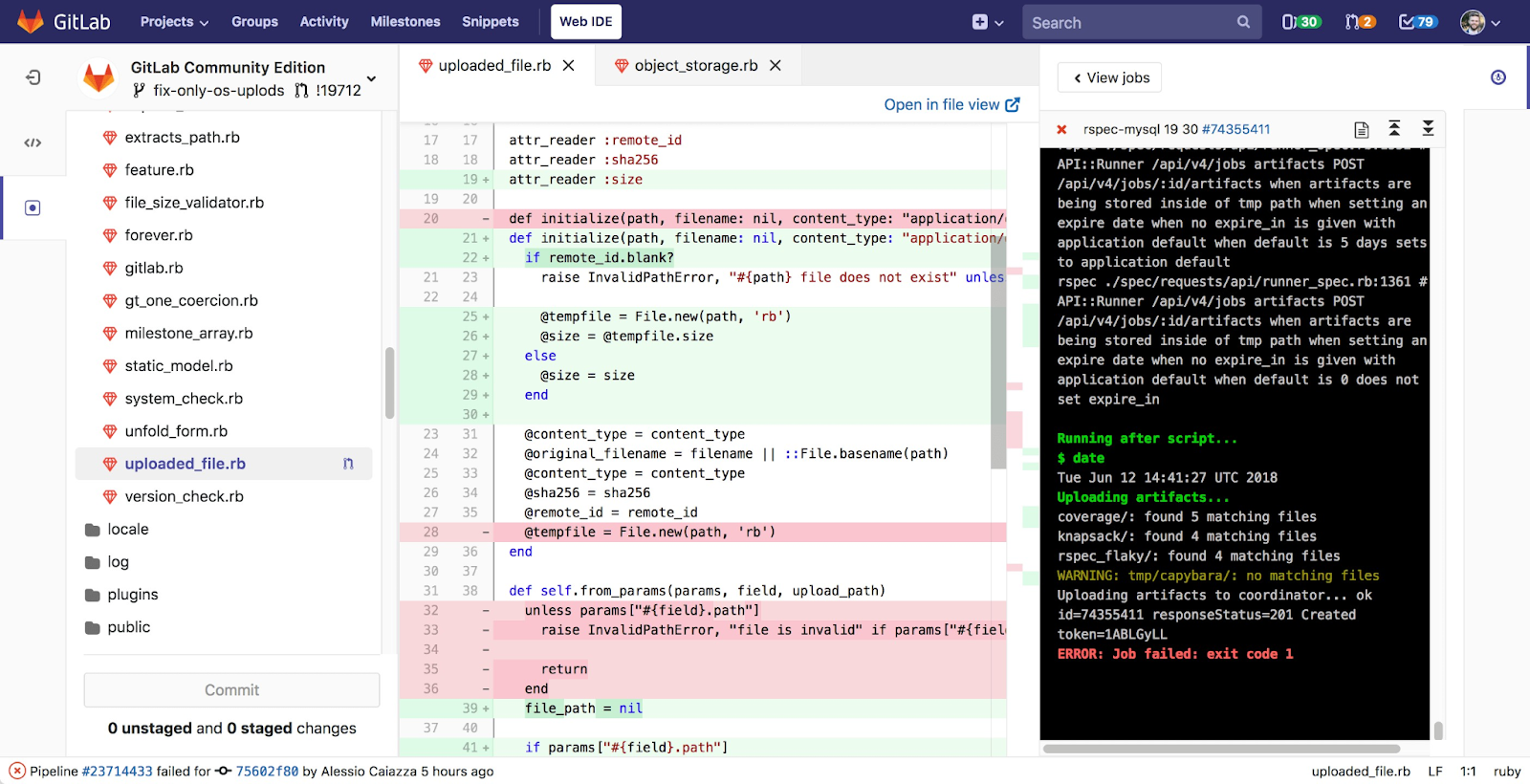
1. GitLab
GitLab Illustration
GitLab is a comprehensive platform that combines version control, continuous integration/continuous deployment (CI/CD), and project management. It provides a single source of truth for your codebase, making collaboration and deployment more efficient. Whether you’re working individually or as part of a software product development company, GitLab helps maintain code quality while enabling seamless integration and delivery.
2. Figma
Figma is a cloud-based design and prototyping tool that fosters collaboration between designers and developers. It allows teams to work on UI/UX design in real time, ensuring alignment between design and development throughout the software product development process.
3. Visual Studio Code
Visual Studio Code Illustration
Visual Studio Code (VS Code) is a versatile code editor that’s favored by many developers. With its extensive library of extensions, VS Code supports a wide range of programming languages and frameworks. Its real-time collaboration feature allows teams to collaborate on code in real time, making it a valuable tool for both individual developers and software product development companies.
4. Selenium
Selenium tool illustration
For software product development that involves web applications, Selenium is a powerful tool for automated testing. It supports multiple programming languages and allows you to create automated tests that mimic user interactions, ensuring the functionality and performance of your web apps.
5. Postman
Postman simplifies the process of testing APIs by providing a user-friendly interface to create and manage requests. With features like automated testing and API monitoring, it’s an indispensable tool for developers building software products that rely on APIs.
6. Jira Software
Project management tool illustration
Jira Software by Atlassian is a widely used project management tool that helps software teams plan, track, and manage their work. It offers features like customizable workflows, backlog management, and issue tracking, making it an excellent choice for teams working on complex software product development projects.
7. Travis CI
Travis CI software illustration
Travis CI is a popular continuous integration platform that automates the testing and deployment of your codebase. It integrates seamlessly with GitHub and supports a wide range of programming languages, making it a go-to tool for software product development teams seeking efficient CI/CD processes.
8. Trello
Trello is a user-friendly project management tool that utilizes the concept of boards and cards to organize tasks. It’s particularly useful for smaller development teams or startups embarking on software product development, offering a visual way to manage tasks and track progress.
9. Zeplin
Zeplin software illustration
Zeplin is a tool designed to bridge the gap between designers and developers. It allows designers to create design mockups and easily share assets with developers, ensuring a smoother handoff and collaboration process during software product development.
10. Slack
Effective communication is crucial for successful software product development. Slack provides real-time messaging, file sharing, and integration capabilities, allowing teams to stay connected and informed throughout the development lifecycle.
Conclusion
As software product development continues to evolve, leveraging the right tools can be a game-changer for your projects. From version control to collaboration, testing, and project management, the tools listed above are designed to streamline your development process, enhance collaboration, and deliver high-quality products. Whether you’re a solo developer or part of a software product development company, these tools can help you stay competitive and innovative in the ever-changing software landscape. Embrace these tools and witness the transformation they bring to your software product development journey.
Remember, selecting the right tools should align with your specific needs and project requirements. By leveraging these tools effectively, you can navigate the challenges and complexities of software product development with confidence and success. One other way is that you can contact Dtech Systems to handle all your development needs.
In the dynamic landscape of technology, the role of a software product development company is pivotal in shaping innovation. As we step into 2023, the evolution of software products continues to reshape industries and drive the digital transformation journey. From cutting-edge technologies to shifting paradigms in development approaches, let’s explore the trends and future possibilities that define the realm of software product development.
2023 Trends of Software Product Development
AI and Machine Learning Integration
AI/ML illustration.
Artificial Intelligence (AI) and Machine Learning (ML) have become integral components of software products developed by leading product development agencies. This transformational integration is also a cornerstone for established development companies, whether they’re customizing software solutions or collaborating remotely.
Enhanced User Experience: AI-driven personalization and recommendations lead to more tailored user experiences.
Predictive Analytics: AI empowers software products to anticipate user behavior and trends, offering valuable insights for decision-making by development companies.
Automation: AI-powered automation, a hallmark of modern software development, streamlines complex processes, reducing manual efforts and errors.
Natural Language Processing: Natural language interfaces and chatbots, harnessed by visionary agencies, offer intuitive interactions and seamless user engagement.
IoT-Powered Solutions
IoT-network illustration.
The Internet of Things (IoT) is reshaping industries and is at the forefront of innovation for any forward-looking software product development company. This trend opens up possibilities for product development in various sectors, driven by agencies seeking disruptive solutions.
Smart Homes and Cities: IoT-powered applications, developed by visionary software product development, enhance convenience and efficiency in everyday life.
Healthcare Innovations: Connected medical devices, championed by agencies, enable remote monitoring and real-time health data collection.
Industrial Automation: IoT-driven solutions, crafted by strategic software development companies, optimize supply chains, manufacturing, and asset management.
Environmental Monitoring: IoT solutions, developed by environmentally conscious companies, help track and manage environmental parameters for sustainability.
Edge computing, a cutting-edge concept embraced by many development companies, is making its mark in 2023. It offers a new paradigm for application product development that’s embraced by progressive development companies.
Faster Response Times: Edge computing, championed by visionary software product development companies, processes data closer to the source, minimizing delays and improving real-time analytics.
Bandwidth Efficiency: Edge computing, a pivotal approach for any future-driven development company, reduces the need to transmit vast amounts of data to centralized servers.
Offline Capabilities: Edge computing empowers software products to operate offline or with limited connectivity, a crucial feature for outsourced companies focused on reliability.
Low-Code and No-Code Development
The demand for faster development cycles has given rise to low-code and no-code development platforms, transforming the way a web/app product development company operates. These platforms empower not only seasoned development companies but also startups partnering with agencies.
Rapid Prototyping: Low-code platforms offer a rapid prototyping environment for a product development, enabling them to create functional prototypes and MVPs quickly.
Cross-Disciplinary Collaboration: No-code platforms facilitate collaboration between technical and non-technical team members, making the development process smoother for any customized software company.
Efficiency: Low-code platforms, embraced by outsourced software product development companies, allow developers to focus on critical coding tasks while utilizing pre-built components.
Cybersecurity as a Priority
Cybersecurity illustration.
As software products become more interconnected, cybersecurity remains paramount for any responsible product development company. This is especially true for a forward-thinking agency and an outsourced company dealing with sensitive client information.
Zero Trust Architecture: Implementing a zero-trust approach, as adopted by leading development companies, ensures stricter access controls and verification processes.
AI-Driven Threat Detection: AI is instrumental in identifying and mitigating potential security breaches, a crucial aspect for any software product development company.
End-to-End Encryption: Data security, a concern for any outsourced company, is ensured throughout transmission and storage.
Sustainability and Green Software Development
Sustainability has become a cornerstone in the vision of a responsible software development company. This commitment is also shared by a conscientious customized software company, recognizing the need to minimize environmental impact.
Efficient Resource Management: A software product development company dedicated to sustainability focuses on creating software products that consume fewer resources.
Reduced Carbon Footprint: Responsible outsourced software product development companies optimize code and infrastructure to minimize energy consumption, contributing to a greener environment.
Eco-Friendly Design: A forward-looking agency prioritizes building products that not only fulfill user needs but also contribute positively to the environment.
The Future of Software Product Development: Meeting Diverse Needs
The future of software product development holds promise and challenges alike. Businesses and industries will look to visionary development companies, strategic agencies, innovative software development companies, adaptive customized software companies, and efficient outsourced companies to navigate this dynamic landscape. With innovation at its core, the collaboration between technology and human expertise will continue to drive product development forward.
Illustration of software team collaboration.
As we embrace the trends of AI, IoT, edge computing, low-code development, cybersecurity, and sustainability, the software products of tomorrow will redefine the way we live and work. Keeping pace with these trends and adopting an agile approach to development will be critical in creating solutions that meet the ever-evolving needs of a dynamic world.
The Bottom Line
In conclusion, the software product development arena is witnessing a remarkable transformation in 2023. The convergence of technology trends and the human drive for innovation promise a future where software products become enablers of efficiency, personalization, and sustainability. Contact us right now if you need any kind of development help or consultation, we’ll be happy to collaborate.